


REVEIW: Scorched Earth - Attic Projects

Scorched Earth
Produced by: Attic Projects (IRL)
Presented by: Brisbane Festival in association with Brisbane Powerhouse
Date attended: 17 September 2026
Direction, Writing & Choreography: Luke Murphy
Rehearsal Direction: Stephen Moynihan
Set & Costume Design: Alyson Cummins
Lighting Design: Stephen Dodd
Composition & Sound Design: Rob Moloney
Audio Visual Design: Patricio Cassinoni
Cast: Luke Murphy, Ryan O’Neill, Sarah Dowling, Tyler Carney-Faleatua, Will Thompson
Voiceover Artist: Eavan Gaffney
Producer: Gwen Van Spÿk
Australian Tour Producer: Lee-Anne Donnolley
Photography: Pato Cassinoni, Emilija Jefremova, Sound of Photography, Teddy Wolff
“Did you love it or just desire it? One is about giving, the other about taking.”

That question burrows deep into Scorched Earth, Attic Projects’ slippery hybrid of dance theatre, crime drama, psychological thriller, and one extremely committed argument about a field.
William Dean is dead. The property developer had returned to Ireland intending to build on land previously leased and lovingly tended by farmer John McKay (Luke Murphy), who wanted to buy it himself. Detective Alison Kerr (Sarah Dowling) brings McKay into an interrogation room, and has 24 hours to prise out the truth. It’s almost a whodunnit... but there's a disputed patch of Irish earth, a community closing ranks, conflicting recollections, and (I promise I didn’t dream this) a missing donkey.

“He wasn’t from here,” we hear repeatedly about Dean, a simple phrase carrying the weight of an entire community behind it. What does it take to be from somewhere? Kerr’s interrogation eventually resembles a hostile therapy session as McKay explains far more than simply where he was on the night of the murder.
Designer Alyson Cummins’ grey interrogation room initially appears straightforward: fluorescent lights, a metal desk, chairs, two-way glass, and a countdown steadily chewing through those 24 hours. Nothing stays straightforward for long though. The glass becomes a radio booth, bar, morgue, mirror, and frame for live tableaux. Furniture changes purpose. Grass starts turning up where grass absolutely shouldn’t be. The theatre itself behaves like an unreliable witness.


Murphy establishes this language through opening tableaux that scatter fragments of the story in front of us before we understand what they mean. Bodies freeze, collapse across furniture, tangle together, or hang mid-action. Patricio Cassinoni’s audiovisual design extends the idea through black-and-white slides of fields, documents, and crime-scene material, while voiceovers deliver autopsy findings, memories, and recollections. Events are replayed through movement, and everybody has their own version of what happened.
The five performers are remarkably versatile storytellers, shifting between acting, contemporary dance, physical theatre, townspeople, memory fragments, corpses, and strange embodiments of the landscape. Slow-motion sequences are so controlled that actions seem caught frame by frame, like evidence being scrubbed backwards for inspection. The treatment of Dean’s "corpse" (Will Thompson) is particularly impressive, his body becoming ragdoll-like as it's rolled, folded, dragged, and flung through extensive floorwork. Portraying dead weight, inconveniently, requires an enormous amount of very alive muscular control.

McKay’s attachment to the land becomes physical through the moss-covered creatures that crawl into his world. A duet between McKay and one of these human clumps of landscape is intimate and aggressive at once, crossing the desk through lifts, grappling, clinging, and contorted embraces. Is he loving the land or wrestling it into submission? Soon three creatures are attacking him and Murphy is somehow carrying all of them at once. Respectfully: muscles?! That strength runs through the whole cast, and by about two-thirds of the way through I’m already thinking, these poor dancers must be exhausted. They haven’t even met the hill yet.
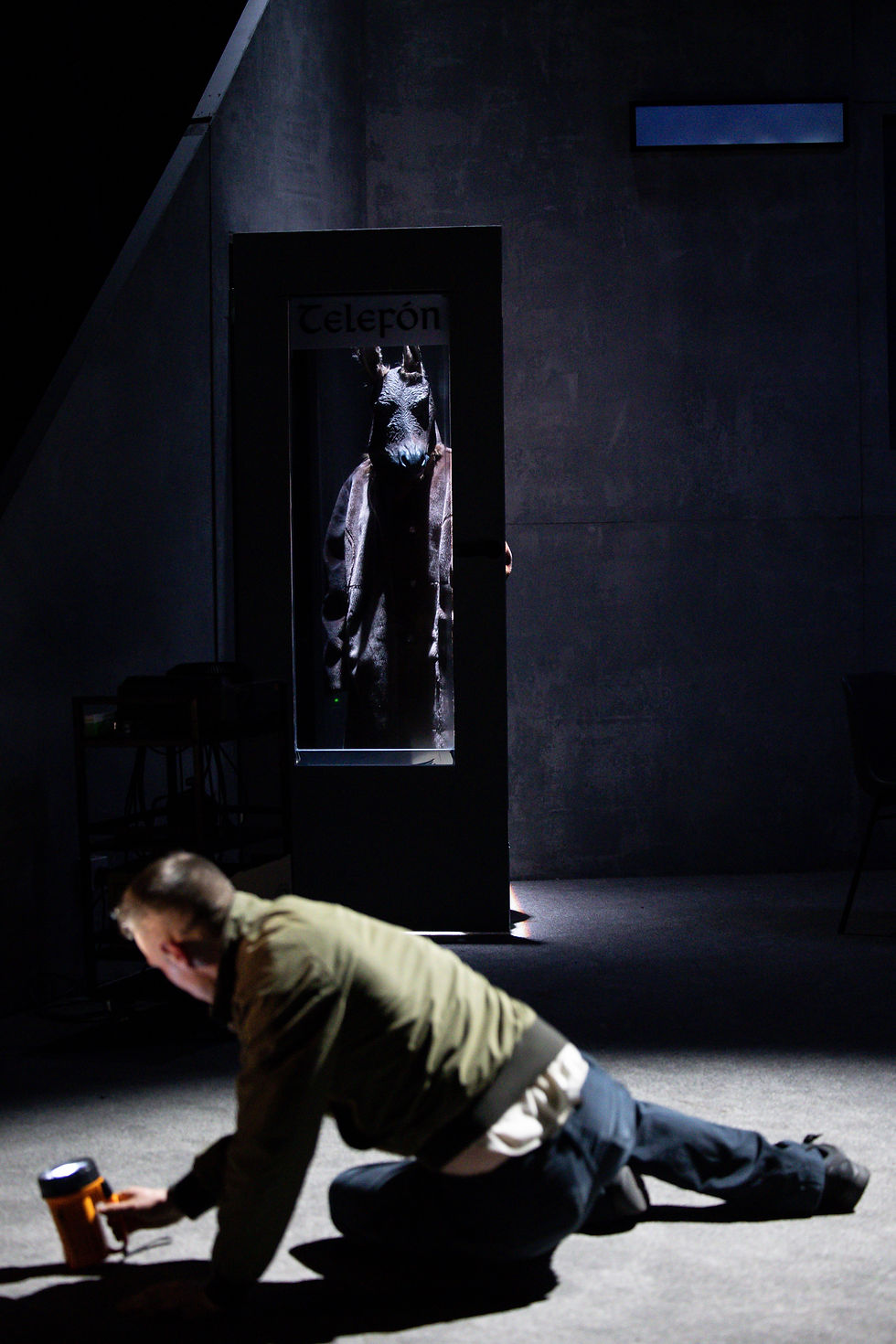
Rob Moloney’s sound design rarely lets the audience settle. Pulsing strings meet Celtic fiddle, EDM, sudden blasts of noise, recorded voices, and intricate foley. Water drips. Feet move through grass. Tiny sounds become enormous. The auction scene uses that pressure particularly well, turning McKay’s desperate attempts to gather enough money for the field into a frantic rush driven by an electronic pulse. As somebody with misophonia, some of the hyper-amplified ASMR-adjacent effects made me want to crawl out of my own skin. Theatre of cruelty indeed. I can appreciate the precision while also begging everyone to stop making noises directly inside my skull.
Stephen Dodd’s lighting continually redirects attention through a production where information can appear anywhere. An autopsy is conducted through dance and voiceover, while another memorable duet uses the reflective glass and carefully manipulated light to split bodies across the space. Even as McKay’s sense of time blurs, the production’s own timing remains exact. Sound, projections, movement, lighting, and scenic shifts have to collide at precisely the right second.


My favourite piece of stagecraft arrives when Scorched Earth decides it has had enough of its own set. As the truth of the murder is described, the cast begin dismantling the interrogation room around McKay. Walls disappear, furniture moves, and flooring is pulled apart while Murphy continues a sequence of violent movements against swelling string music. The performers suddenly become their own stage crew, stripping away the physical world of the interrogation at the same moment McKay’s story is being stripped down. After spending the night watching one room constantly change identity, Attic Projects finally tears the whole bloody thing apart. And what it has been hiding is enormous!
The light gradually rises over a huge sloped field of grass occupying the back of the stage. It has been sitting there all along. The interrogation room suddenly seems tiny in retrospect, and the dancers now have to confront the land physically. They sprint uphill, scramble, slide, tumble back down, roll, jump, and crawl as layers of sounds heard throughout the performance re-emerge to gather around them. By the end, five exhausted bodies are reduced to battling gravity. They climb. The hill sends them back. They climb again.
Another triumph from Attic Projects. Their production of Volcano still takes the cake for me, but Scorched Earth is an entirely different beast, built from a different theatrical language and a design that keeps finding new ways to wrong-foot us.


Comments