


REVIEW: Dead Bat on the Night Shift - Observatory Theatre

Dead Bat on the Night Shift
Presented by: Observatory Theatre
Venue: PIP Theatre
Date attended: 27 August 2026
Written by: Samantha Hill
Director / Set Design / Costume Design: Lachlan Driscoll
Dramaturg: Emma Churchland
Vision Designer: Freddy Komp
Sound Designer / Stage Manager: Hannah Page
Lighting Designer: Noah Milne
Photography: Images by Anderson / Creative Futures Photography
Content warnings: Coarse language, sexual references, misogynistic and racist language, fake firearm, gunshots, staged violence, fake blood, haze, and sudden flashing lights.
“Hey Siri. How to murder...?”
Written by Samantha Hill and presented by Observatory Theatre at PIP Theatre, Dead Bat on the Night Shift centres on Sloane (Claire Pearson), an intelligent, withdrawn employee who's come up with a dramatic plan to improve workplace morale. Her solution? Give her boss a permanent vacation. Six feet under. To be fair, Dave is the worst.

I just recently watched 9 to 5, and it seems like I picked an excellent week for watching fictional office tyrants. Darren King as Dave sits comfortably among those men who mistake a tiny bit of managerial authority for evidence of their own superiority. He’s a sexist, racist bully who’s extremely comfortable making everyone else squirm. The audience kept up a chorus of groans whenever Dave launched into another revolting scene. You could feel the reaction ripple through the room, especially from the women hearing a fictional man say something we’ve all, unfortunately, heard some version of before. King gives Dave exactly the kind of cringey swagger that makes him painfully familiar.

When we walk in, Sloane is already onstage, rocking the ultimate comfort combo of a hoodie, sweats, and a fanny pack. She’s giving the wall her best dissociative stare. Around her is a deliberately miserable office of grey surfaces, boxes, and a whiteboard covered in the sort of workplace nonsense that suggests somebody attended a management seminar and returned with several markers and no useful ideas. Customer service has rarely looked so bleak.

Claire Pearson does a lot of the heavy lifting in this show, with Sloane onstage for almost the entire 150 minutes. She doesn’t say much for long stretches, instead expressing herself through internal asides, sudden outbursts, quirky facts, and wonderful facial reactions. Some parts of Sloane's character might really resonate with neurodivergent folks. She retreats into facts rather than socialising, likes systems that make sense to her, struggles to express emotion directly, and seems way more at ease planning a complex murder than chatting about the weather at work. There are even binders involved in said planning. She is also enormously capable, yet almost none of her strengths are valued in a workplace more interested in whether she can perform the expected version of customer-service friendliness.

Pearson understands the power of stillness. Sloane is like a pressure cooker for most of the play, holding everything in and giving very little away. You can tell there’s always far more happening underneath than she knows how to express. So when that restraint finally cracks, it really hits. At one point, Sloane screams, and the sound went straight through my soul. It was like years of frustration, grief, rage, and all the words she has never been able to say coming out at once.

Much of that history takes physical form through Clara (Ellen Hardisty), Sloane’s deceased mother and ultimate ghostly bully. She taunts Sloane, puts her down, and voices the cruellest things Sloane believes about herself. With exposed brain tissue and torn clothing from the car accident that killed her, Clara is a pretty horrifying sight (and that’s before she opens her mouth). But what she represents is even worse. She becomes the embodiment of Sloane’s unresolved abandonment, carrying the damage left by a mother who gave her up to foster care.
Hardisty also plays another Clara, completely unrelated to Sloane’s mother. Office Clara is firm, quiet, and strong, carrying her own private grief. Hardisty separates the two women beautifully, giving one a vicious, needling presence and the other a quiet resilience. The doubling also works nicely in a play so interested in identity and the versions of people we create in our own minds.
And then there is the dearly departed bat. Sloane finds a dead bat outside work and starts carrying it around. Calum Johnston’s puppet is macabre, peculiar, and somehow increasingly companionable as it begins to “speak” to her. That is the strange charm of Samantha Hill’s writing. The absurdity keeps opening little doors into something sadder. For all its dark comedy, Dead Bat on the Night Shift has a real soft spot for the odd little families that form in terrible jobs. You might hate the workplace itself, but sometimes the coworker beside you is the only reason you make it through another shift.

Jaxon Norman gives Jonathan an instantly gentle quality. He’s helpful and sweet without needing a flashing “Nice Guy” sign above his head. In Sloane’s world, where she expects criticism, abandonment, or misunderstanding, simple kindness really counts. Clarise Ooi brings bright, distinctly Gen Z energy to Aysu. She’s the lively uni student of the group, full of youthful optimism and momentum.
Jenna Murphy became one of my favourite recurring presences throughout the show. Pamela, bless her heart, is a bit of a doormat but stays relentlessly positive despite being injured (wrist guard and all). Murphy keeps popping up as a Centrelink worker, gun seller, glow-worm tour guide, and plenty more. Her comic instincts make each one distinct, and by the time another variation of “Pam” appears, simply recognising her becomes part of the joke.

Lachlan Driscoll’s direction keeps us firmly inside Sloane’s world. She becomes our guide, speaking directly to us through narration and asides, while completely zipping up around the people actually standing beside her. Those moments are invisible to everyone else, and sometimes all it takes is one quick glance out to us (very The Office) to say exactly what she’s thinking. The world around her stays fluid too, with rapid scenes, actors shifting between characters, and simple visual changes moving us between settings.

Driscoll's costume design tells us plenty as well. Sloane begins in clothes built around comfort, practicality, and invisibility, as though being unnoticed is preferable to being perceived. Later, she changes onstage into more conventionally professional clothing, making the transformation part of the storytelling. Jonathan’s preppy young-adult look suits his gentle manner, Aysu is unmistakably a Gen Z uni student, Office Clara dresses with sensible Gen X practicality, and Pamela’s brighter colours match her determined positivity. Dave, meanwhile, is just... Dave.
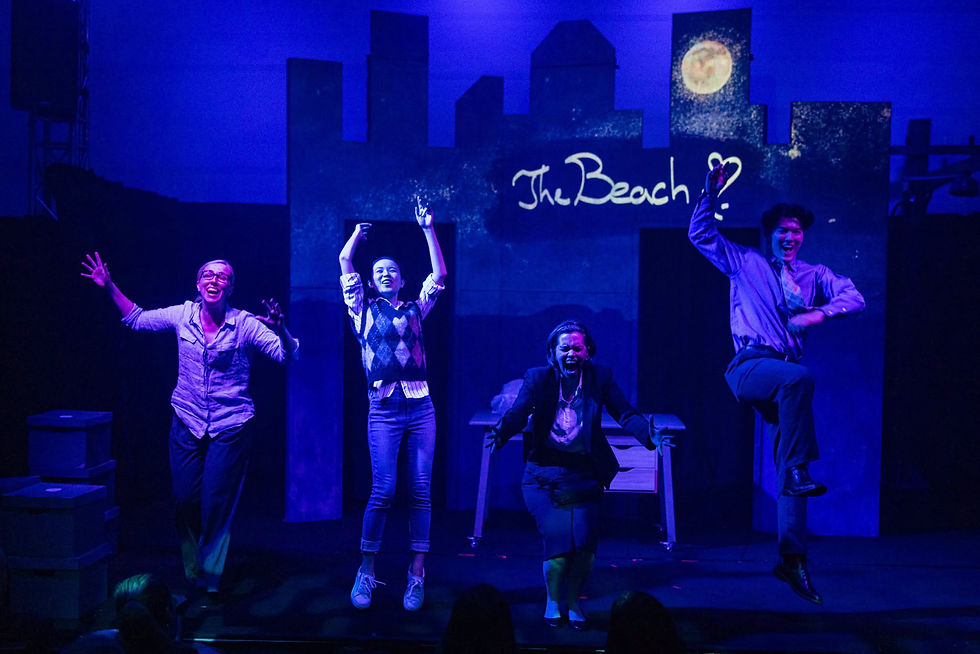
Freddy Komp’s vision design extends Sloane’s inner world through drawn projections of buildings, beaches, caves, offices, bookshelves, and other environments. Their chalkboard-like style gives the whole thing a hand-drawn quality, as though we’re watching Sloane’s imagination sketch the world around her. Noah Milne’s lighting and Hannah Page’s sound are woven tightly into the action. A lot of the comedy relies on cues landing at exactly the right moment, and they do. Voiceovers, gunshots, flashes, and sudden shifts between Sloane’s external and internal worlds all land with sharp timing. Lastly, motifs of bats, twelves, and tarot cards appear throughout the story, tying into ideas of cycles, fate, prediction, and whether our futures are already set or still ours to mess with.

One line cuts straight through all of it: “How dare you dream so small for your life?!” That, far more than the murder plot, feels like the challenge at the centre of Hill’s play. Samantha Hill began writing Dead Bat on the Night Shift 20 years ago as a young graduate feeling stuck, uncertain, and unseen. That backstory adds another dimension now. The frustrations of thankless work are funny because, let’s face it, they’re still painfully familiar for plenty of us. But the play also understands why telling someone to “just quit” or “find something better” can be wildly unhelpful. Choice gets complicated when life has taught you to expect very little.

Sloane even goes through the torturous process of Centrelink and JobSeeker (iykyk), turning the whole thing into a bureaucratic circus. Quitting a lousy job is one thing. Then comes figuring out what’s next, proving you deserve assistance, dealing with judgement from strangers, filling out a thousand forms, and somehow staying sane through all of it.
Sloane may be very good at planning a murder, but figuring out what she actually wants from her own life is much harder. For all its terrible bosses, maternal trauma, murder prep, and dead bats, Dead Bat on the Night Shift still has a surprising amount of heart. It will particularly appeal to audiences who enjoy black comedy, theatrical absurdity, and character-driven contemporary writing. It’s weird, funny, and is certain to catch you off guard.


Comments