


REVIEW: Drowning Ophelia - Centenary Theatre Group

Drowning Ophelia
Written by: Rachel Luann Strayer
Presented by: Centenary Theatre Group
Date Attended: 19 July 2026
Directed and Set Design by: Rhyll Bucknell
Lighting and Sound: Brian Hobby
Photography: Julie Collins and William McCreery-Rye
“Lord, we know what we are, but know not what we may be.”
Ophelia has been a familiar presence on Brisbane stages this year. Most of us know her story from Shakespeare’s Hamlet: a young woman overwhelmed by grief, driven towards madness and ultimately found drowned in a river. Taylor Swift has even recently added The Fate of Ophelia to the cultural conversation. Still, finding Ophelia sitting in a bathtub at the beginning of Drowning Ophelia raised a few new questions. Why is she there? Can the other characters see her? And is there actually water in that thing?
Presented by Centenary Theatre Group and directed by Rhyll Bucknell, Rachel Luann Strayer’s Drowning Ophelia explores memory, repression and the confusing grief of losing someone you once loved, even when they were also responsible for your trauma.

The play opens with Jane rummaging through a collection of costumes while Ophelia sings and splashes in the bathtub behind her. It appears that Jane regularly pays Edmund to join her in acting and improvisation exercises, moving through a medieval characters, Regency roleplay and a 1950s housewife fantasy. Why they started doing this is never fully explained... But what is clear is that Jane finds comfort in make-believe worlds she can construct for herself, where every costume, character and conversation can be controlled. Edmund commits to each scenario with amusingly grand seriousness, while both actors perform their roles with deliberate stiffness and awkwardness. Ophelia, however, refuses to follow the script or remain quietly in the bath. Because Edmund cannot see her, he is completely unaware of the battle for Jane’s attention unfolding beside him.
As the production moves between the present, memory and imagination, Jane’s history gradually comes into focus. Ophelia appears to be a hallucination and a manifestation of Jane’s younger self, still demanding to be acknowledged. She seems able to speak only through quotations from Hamlet, along with fragments of Jane’s own words that she repeats as though trying to understand them. Whenever something draws Jane closer to thoughts of her older brother Adam, Ophelia sings and grows increasingly disruptive until she can no longer be ignored. It's a clever device, turning the past into something physical: trauma sitting in a bathtub, soaking wet, endlessly quoting Hamlet.
Caitlin Swan gives Ophelia a restless, childlike quality at first, quietly singing to herself. But the longer Jane denies her existence, the more desperate she becomes. Swan turns that desperation into something completely raw, singing and shouting over the dialogue while splashing Jane in an attempt to force her attention. Despite spending much of the performance in the bath, Swan still finds plenty of physical and vocal variety within it. Also, the front row should consider itself warned: Ophelia is not shy with the water!

Madelaine Harte gives Jane an expressive performance, particularly through her facial reactions. Jane’s tension sits buried beneath a numb appearance and a series of obsessive routines, with flashes of discomfort and panic breaking through while the rest of her remains tightly controlled. I would have expected to see that restraint unravel more as the memories become harder to suppress, but Harte still captures Jane’s emotional conflict convincingly. She also does a brilliant job of continuing her scenes with Edmund while her character (mostly) resists the urge to react to the commotion beside her.
Federico Navarro has plenty of fun with Edmund’s theatrical side. He throws himself into each roleplay scenario with a suitably haughty delivery. At the same time, Navarro keeps Edmund’s genuine concern for Jane present throughout. A quieter scene gives him the chance to show the character’s empathy more openly, revealing greater depth beneath all the cosplay.
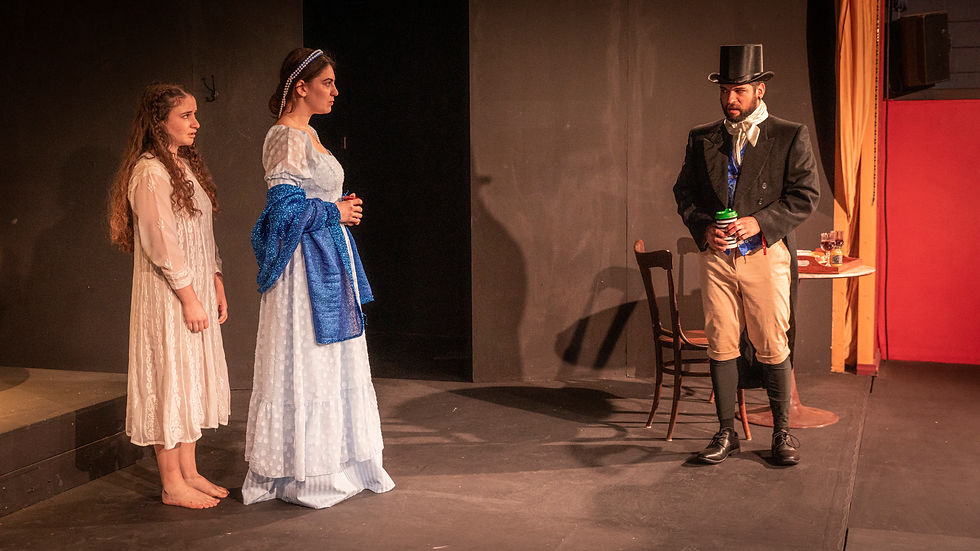
Timothy De Vroome makes Adam unsettling from the outset, with a stiffness that leaves something slightly off about him even in the earlier memories. That discomfort works once the darker truth emerges, though I would have expected more warmth in his relationship with young Jane beforehand. A stronger glimpse of the brother she once adored would have made the betrayal more painful and helped us understand why her grief remains so tangled.

Visually, the stripped-back set allows the different realities to overlap easily. The mostly bare stage contains a raised bathtub platform and a small café-style table and chairs. Ophelia’s white lace nightdress gives her a ghostly, innocent quality, while Jane and Edmund’s roleplay costumes are well designed. Brian Hobby’s lighting and sound helps separate memory, reality and imagination.
The play is divided into two acts with an interval, and this is where I struggled somewhat. The script relies heavily on repetition, quotations, and introspection rather than building dramatic momentum, and I found my attention drifting. The material is meaningful, but the pacing kept me at an emotional distance when I wanted to feel more connected to Jane’s journey. Jane is not only processing childhood trauma. She is also mourning a brother who was once her playmate, protector and source of affection, while confronting the fact that he was also responsible for her abuse. The play does not offer a neat answer or suggest that forgiveness is the way forward. Instead, it focuses on the difficult process of acknowledging what happened and allowing the silenced part of yourself to speak.
I would not describe Drowning Ophelia as a dark comedy. It's a confronting production centred on abuse, trauma and suicide. It's not quite my style of theatre, but I appreciated its unusual theatrical language, strong central metaphor and Caitlin Swan’s raw performance. It will likely connect most with audiences who enjoy quiet psychological drama and work that leaves space for interpretation rather than offering easy closure.


Comments