


REVIEW: Footloose – Communication in Action

Footloose: Youth Edition
Presented by: Communication in Action
Venue: Talbot Theatre, Thomas Dixon Centre
Date Attended: 1 August 2026
Director: Tim Hill
Musical Director: Jacqui Devereux
Choreographer: Justin Anderson
Photography: By B'rit Creative
“Honouring their memory by shutting out the world isn't working.”

For a musical best known for dancing, denim, and Kenny Loggins, Footloose has a surprisingly serious point to make. Grief has settled over the small town of Bomont, and Reverend Shaw Moore’s response has been to tighten his grip on everyone around him. Dancing is banned, teenagers are curfewed, and having fun is viewed as a dangerous slope towards catastrophe. Then Ren McCormack arrives from Chicago, eager to shake things up with his energetic spirit and complete inability to stand still.

Communication in Action’s Footloose brings together a cast spanning all school ages for a compact version of the musical, created in only five intensive rehearsals. At the centre of the production was Diesel Batson as Ren. He had the confidence of a natural leading performer, combining a strong singing voice with charming character, and sharp dance technique. He knew how to command the full stage, and “I Can’t Stand Still” gave him an early opportunity to show exactly what he could do, complete with agile vocal runs, playful acro, and some very cool dance moves. And his acting held up just as well when Ren stopped moving. His frustration at being judged by the town was convincing, and during “I’m Free,” his confrontation with Reverend Moore became so real that I briefly forgot I was watching two teenagers. Both performers found the anger and pain underneath the argument and really went for it.

Henry Marsh carried himself with wonderful authority as Reverend Shaw, with rigid posture and a stern delivery that immediately established who was in charge. His voice was rich and secure, while his performance allowed glimpses of the frightened father behind the town leader.
Rose Statham brought a powerful soul quality to Ariel’s vocals and plenty of fire to her rebellion. She was especially strong when Ariel pushed back against her father and the authority surrounding her. Statham and Batson also sounded lovely together in “Almost Paradise,” with well-matched tones and harmonies. Their quieter connection gave the show some breathing room between the larger company numbers.


The production’s girls were consistently formidable. Ella Reynolds, Emily Carrick, and Lillian Wilson formed a very funny trio as Urleen, Wendy Jo, and Rusty. While several of the youngest performers supplied “Somebody’s Eyes” with an impressive amount of sass (I’m sorry, tiny scene-stealers, I don’t know your names). “Holding Out for a Hero” became a full girl-power showcase, driven by strong solo singing and choreography that gave performers across the group their own moments.

Then Lillian Wilson arrived with “Let’s Hear It for the Boy” and attempted to remove the theatre’s roof. Wilson carried the number with extraordinary vocal confidence, producing a belt that would be impressive from an adult performer, let alone someone her age! Her Rusty was excitable and immensely likeable, which made her a great match for Archer Grounds’ equally enthusiastic Willard. Grounds embraced Willard’s awkwardness and broad comedy while keeping him endearing.

Jolie Sainsbury felt completely natural as Ren’s mother, Ethel, bringing an easy warmth to the role. Dorothy Grounds also impressed as Vi Moore, particularly in “Can You Find It in Your Heart?” Her lovely vocal tone and controlled delivery made it one of the production’s quieter musical highlights, giving Vi a welcome moment of her own within the larger conflict between Shaw and Ariel.

Among the supporting cast, Cooper Wolski made an impression as the Principal. That guy is destined to become either a school principal, a politician, or somebody who carries a clipboard and expects answers. His authority was startlingly convincing. Henry Woodward also used every second of the Coach’s limited stage time and absolutely made those few appearances count. Joshua Ngo gave Chuck an appropriately threatening edge, while Darci Allen, Bella Pietrobon, Bharathi Kumar, Saana Chang, and the remaining featured performers helped populate Bomont with distinct personalities. One of the strengths of this adaptation was just how many speaking and musical opportunities were spread throughout the ensemble.

Tim Hill and Justin Anderson made smart use of the wide Talbot Theatre stage, creating formations that gave the large cast plenty of room to move. With so many bodies regularly flying around, there was always something to catch the eye. Jacqui Devereux’s musical preparation was equally apparent. The company harmonies were confident, particularly during the final “Footloose,” and the lead vocals remained secure despite the amount of movement involved. The finale brought the whole company together with partner work, strong harmonies, and the satisfying sense that Bomont had finally unclenched its collective jaw.
Digital projections established each setting, moving between the church, school, diner, council meeting, and country dance hall. The screen became a useful visual anchor, while the open playing space allowed Anderson’s choreography to spread out. The audience rat run was also used to vary the blocking and bring parts of the action closer. Costumes immediately placed us in small-town America with denim, plaid, florals, and plenty of boots, while the American accents were remarkably consistent across such a wide range of ages.
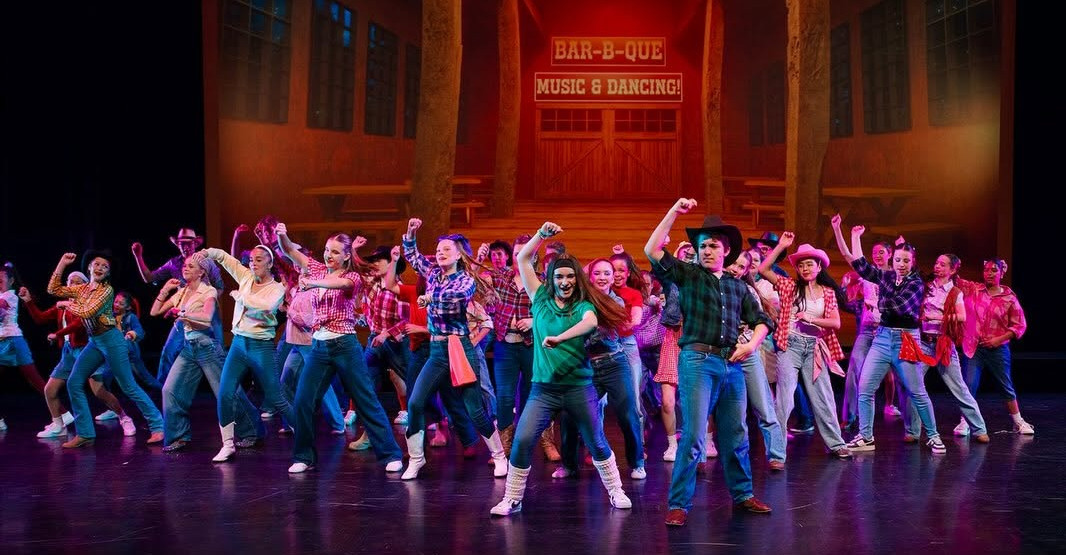

As I attended the dress rehearsal, my only performance note is very much a dress-rehearsal one. A few students could continue working on keeping their eye-lines lifted and their faces open to the audience. With so many performers sharing such a large stage, looking down or turning inward can make an individual disappear surprisingly quickly. Communication in Action’s young performers were remarkably disciplined. There were strong voices across the cast, standout dancers, and several young actors who already know exactly how to hold a stage.
Footloose gave this enormous group of young performers plenty of room to show what they could do. By the final number, the stage was completely theirs, and they looked like they were having an absolute ball owning it.




Comments