


REVIEW: Freshblood Festival – Vena Cava Productions

Freshblood Festival 2026
Presented by: Vena Cava Productions
Venue: VENTspace, South Brisbane
Date Attended: 9 August, 2026
Festival Theme: RISK IT!
Shows reviewed: It’s Always the Wife, Winging It, Rule of 4, Making a Killing, and Is Our Roommate a Nazi?
Freshblood is an annual festival devoted to new work from emerging writers, directors, performers... And this year’s theme was RISK IT! Creatives were encouraged to unleash their wildest ideas, experiment with form, design, and performance, and try things they might not usually get away with in a more traditional festival brief. With nine MainStage productions, four play readings, musicians, and visual artists, the vibe was all about making the weird stuff and seeing what comes of it.

I couldn’t catch everything though! I missed Endangered Species, Flat Earth Party, We Are in Your House, Things We Shouldn’t Talk About, and the play readings, so this isn’t a review of Freshblood in its entirety. Instead, consider this a reflection on the particularly comedy-heavy corner of the festival I did manage to see.
It’s Always the Wife
Writer/Director: Christina McMahon
Production Manager: Mitchell Pyke
Cast: Abigail Thomas, Jaimee Jessop, Maddison Grace, Zara McCarthy, Noah Redshaw, Jack Winrow, and Alex Thompson

It’s Always the Wife wastes absolutely no time throwing us into the whodunnit puzzle. Jaimee Jessop and Jack Winrow kick things off as an older married duo engaging in some magnificently clumsy marital relations, only for the husband to dramatically drop dead. Abigail Thomas enters as the detective who has been just itching for a murder to solve. Accompanied by her emotional support teddy bear, she barrels into the investigation with enormous confidence and little competence.

Christina McMahon’s script takes the familiar conventions of a whodunnit and film noir, then cheerfully fills them with nonsense. Characters break the fourth wall, dialogue tips into absurdity, and perfectly placed sound effects keep everything moving. Meanwhile, the cast understand exactly how seriously they should be taking this (not very).
Winging It
Writer/Director: Laura Szabadics
Sound Designer: Will O’Shaughnessy
Lighting Designer: Bridget Kerwin
Vision Designer: Charley Tusler
Cast: Reid McWha, Josh McQueen, Aidan Calleja, and Abigail Thomas
“There’s something freaky going on inside this house.”

Set in 2080 in Birdsbane, three roommates live inside a futuristic funhouse where birds are the superior species, doors can lead absolutely anywhere, the kitchen is extremely difficult to locate, and a mysterious voice from above (Abigail Thomas) provides instructions of varying usefulness.
Laura Szabadics’ script is absurd, clever, existential, and very strange. Each new discovery kicks the roommates into another scenario, so the piece has the loose, anything-could-happen energy of improv even though the physical sequences are obviously tightly rehearsed. Reid McWha, Josh McQueen, and Aidan Calleja are well matched here. Their mime, reactions, timing, and physical comedy are so coordinated that scenes feel spontaneous. With no physical set or props to rely on, they have to build the house entirely through movement, interaction, and shared imagination. They’ve also got MOVES. Sort of...
Every “door” presents another possibility, from time travel to increasingly bizarre corners of this bird-controlled universe. There’s Big Bird (in the Big Brother sense), celebrities like Zendaya receive avian alterations (Hen-daya), and the audience even receives little origami birds. Aww!
The video and sound design stretch the empty space beyond what is physically there, particularly during the more fantastical sequences. The lack of scenery ultimately works in the production’s favour because we are invited to build this world alongside the performers. At one point comes the observation:
“We are spoiled with all these doors.” Yes, yes. Symbolism. Look at me analysing the bird show... These young people are surrounded by endless doors, endless possibilities, and absolutely no idea where any of them could lead, which is exciting! Winging It is weird, imaginative, and appropriately egg-istential.
Rule of 4
Writer/Director: Ben Spalding
Lighting Designer: Riley Montesin
Sound Designer: Ellena Ramsay
Stage Manager: Kaitlin Ritchie
Cast: Aidan Calleja, Ella Marshal, Hunter Sams, and Anna Blinks-van Broekhoven
“Magic isn’t real, folks. It’s just people lying to your face.”
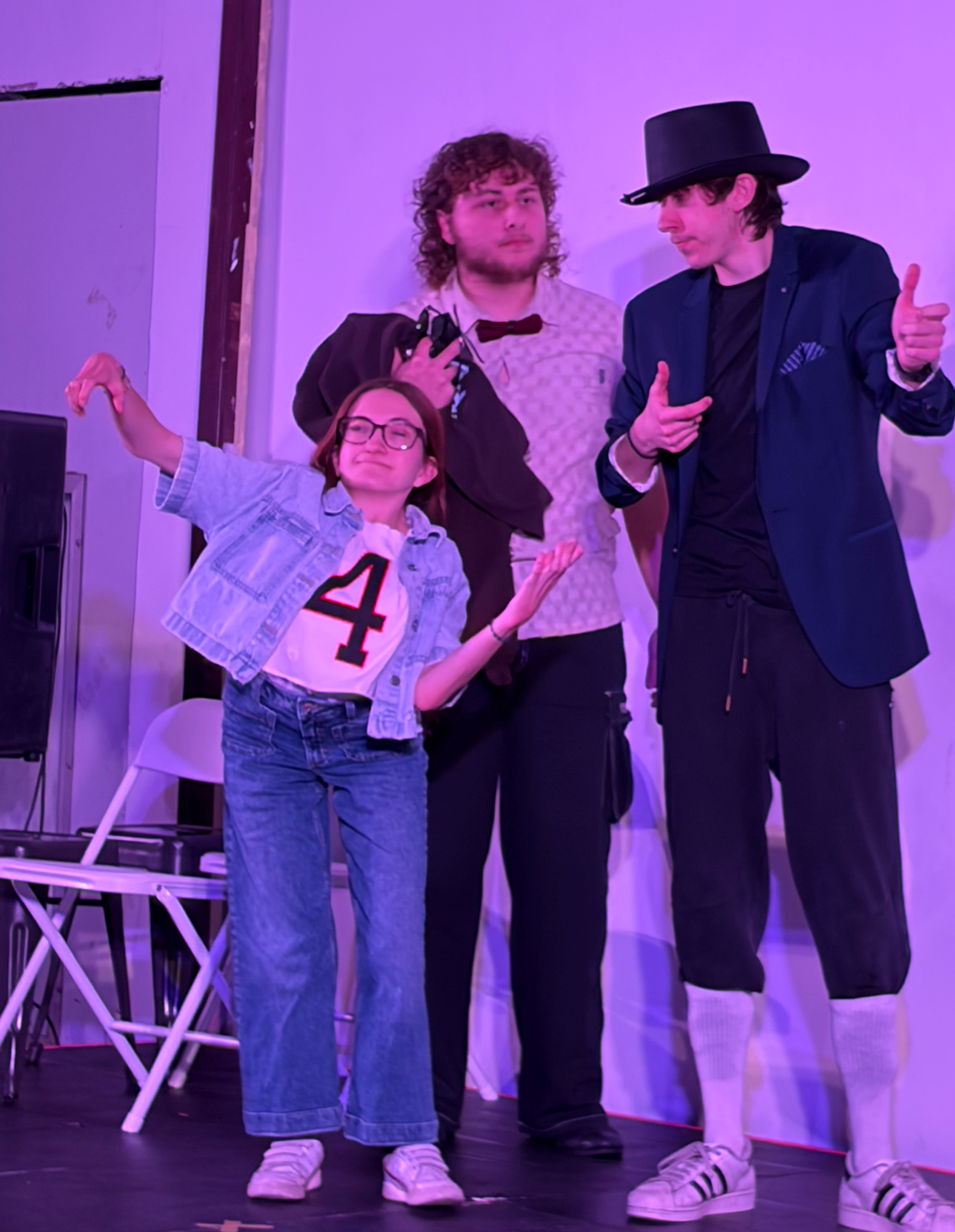
Rule of 4 presents itself as a show starring a magician, his assistant, his ex-girlfriend/audience plant, and a guy whose primary contribution to conversation is the word “four”. Ben Spalding’s piece throws scripted comedy, improvisation, deliberately unsuccessful magic, audience interaction, narrative detours, and repeated appearances of the number four into one extremely odd pot. I don’t think I could confidently explain the plot to you even under interrogation.

Aidan Calleja is very good at playing the untalented magician. Hunter Sams’ character initially communicates almost exclusively through “four”, giving shades of Hodor/Groot, until the production eventually helps matters by providing him with surtitles. The audience was very willing to play along, which is vital for this kind of work, and the show happily wandered in several directions before eventually surprising us with some actual magic towards the end. Noice.
Making a Killing
Writer/Director: Ad Reid
Lighting Designer: Pavani Wickremasinghe
Sound Designer: Celine Terisno
Stage Manager: Claire (CJ) Stockwell
Cast: Ella Marshal, Nicholas McMahon, Jaimee Urika, and Annabel Baker
“Want a real story? Kill someone people actually give a shit about!”
Making a Killing takes us to a struggling café on a run-down rural QLD main street, where businesses are suffering, rent is ridiculous (relatable), and things suddenly become much busier when a murderer starts poisoning people with toxic berries. Journalists descend upon the town. Business picks up. Tragedy turns out to be excellent for the local economy.

Ad Reid’s script has a darker satirical edge beneath its comedy, particularly in the uncomfortable relationship between human suffering, media attention, and the financial opportunities surrounding both. Café workers Sandy, Nate, and Elsie (Ella, Nicholas, Jaimee) become more mysterious as the deaths continue, and because practically everybody now has something to gain from the situation, suspicion spreads very quickly. The script ultimately leaves certain questions hanging rather than wrapping everything into a neat little bow, which suited this story where moral certainty becomes increasingly difficult to decipher.
Annabel Baker gets some particularly entertaining moments across her multiple roles, including an extremely angry teenager named Gavin. Radio updates scattered throughout the production keep the murders moving beyond the walls of the café. During the performance I attended, some dialogue became difficult to catch when actors turned away from the audience. A few lines disappeared into the space, so stronger projection and more awareness of body position would help the details stay clear.

Is Our Roommate a Nazi?
Writers: Kodi Ryke and George Aitken
Director: Oliver Primrose-Motum
Cast: Lachlan Kruger (Joey), Jack Winrow (Dwight), Edith Malcomson (Home Owner/Friend 1), Reagan Warner (Narrator), Midori Cruz (Friend 2), and James Grant (Charlie)
“Maybe he’s an ironic Nazi? Maybe he doesn’t like juice? (jews)”

If any title announced RISK IT! before the actors had even walked onstage, this was probably it. Joey and Dwight suspect their new roommate Charlie might be a Nazi. Unfortunately, every piece of evidence is just ambiguous enough to make it harder to tell.
Kodi Ryke and George Aitken’s writing deliberately treads through uncomfortable territory, using the structure and language of a sitcom to examine prejudice, assumptions, reputation, performative tolerance, and the spectacular ways people can dig themselves into holes while trying desperately to prove how progressive they are. The production directly acknowledges us throughout, complete with sitcom-style introductions, a laugh track, direct address, audience interaction, and Reagan Warner’s narrator reacting with every available muscle in his face even when he isn’t saying a word.

Lachlan Kruger and Jack Winrow make a strong comic pairing as Joey and Dwight, particularly during their interrogations of Charlie. James Grant keeps Charlie maddeningly difficult to read because almost everything he says manages to be both suspicious and completely inconclusive. Things get worse once Joey and Dwight attempt to explain themselves to Charlie's friends, played by Midori Cruz and Edith Malcomson. Every attempt to prove they aren’t bigots produces another sentence that makes them sound worse. Winrow, in particular, has excellent timing when Dwight realises (a second too late) that he has once again said the worst possible thing.

And the awkward silences are just as funny as the punchlines. There were moments when the audience chuckled immediately, gasped, wriggled, or sat in uncomfortable silence while we calculated whether laughing was socially permitted. That discomfort is part of why the piece works well. The humour mostly comes from Joey and Dwight’s panic, contradictions, assumptions, and frantic attempts to protect their own reasonings.
Of the five productions I caught, this one perhaps most obviously embodied the RISK IT! brief. It went somewhere uncomfortable, trusted its audience to recognise what was actually being satirised, and committed to the consequences.

Final Thoughts

What I enjoyed most about my little slice of Freshblood was how little interest these emerging artists had in behaving sensibly. None of these five pieces were particularly naturalistic in structure. They played with direct address, audience interaction, physical comedy, multimedia, genre parody, improvisational structures, and theatrical conventions. Some ideas were more clearly developed than others, but that almost feels beside the point in a festival built specifically to encourage experimentation. Freshblood isn’t asking artists to arrive with the safest possible finished product. It gives them somewhere to try the weird thing.

For emerging creatives, having somewhere to test those ideas in front of an actual audience is invaluable. You learn what lands, what needs tightening, what audiences understand, what they don’t, and which premise might actually have a future beyond the festival. I only saw five of Freshblood’s MainStage works this year, so there’s a whole other side of RISK IT! that I missed. But from the five I did catch, Vena Cava’s young creatives certainly understood the assignment. They risked it. And theatre is considerably more interesting when somebody does.



Comments