


REVIEW: Home, I'm Darling - Swich Up Productions

Home, I’m Darling
Presented by Swich Up Productions
Attended: 18 July 2026
Written by: Laura Wade
Directed by: Martie Blanchett
Assistant Director: Simone Behrendorff
Set Design: Adrian Carr
Lighting: Doug Brimblecombe
Sound: Brendan Dieckmann, Seven Yuenyang and Martie Blanchett
Stage Manager: Pru Valentine
Costumes: Simone Behrendorff and team
Intimacy Coordinator: Ellen Axford
Choreography: Madz O’Hare
Photography: Kris Anderson and Isaac Frommelt
“You are wasting your life, when you could choose not to!”
In Judy’s world, every day is a matinee performance of domestic perfection. Judy (Lauren Ryan) and Johnny (Michael Civitano) are a modern married couple who have agreed to live as though it is the 1950s. Johnny goes to work while Judy cooks, cleans, mends, gardens, and runs the household like a sitcom super-wife. She abandoned her corporate career to pursue what she calls “a deep, quiet kind of happy.” From the outside, it's all twirly skirts, freshly baked treats, and jive dancing. Meanwhile, the bills are piling up and the happy housewife smile is starting to ache.

Swich Up Productions sets up the retro world of Home, I’m Darling with jukeboxes, vintage posters and smartly dressed staff. This company has a keen eye for detail and knows how to draw its audience into the experience, making the venue an active part of the production rather than simply somewhere to watch it. The old Cambrian Centre in Booval is a great fit for this nostalgia-soaked play. It becomes a gingham wonderland where Judy’s version of the past comes alive.
Adrian Carr's set design is also crafted with great attention to detail. It features pastel shades of yellow, pink, and mint green, complemented by a checkerboard floor, retro appliances, antique furniture, and delicate dishware. Even the fridge hums! The sourcing alone must have involved raiding every op shop, grandma’s kitchen, and vintage marketplace within driving distance.

The practical details help sell the illusion, right down to the real tea, actual meals, and household props. Judy’s routines feel properly lived in as she moves through them with practiced ease, always pouring, serving, or fussing over something. Martie Blanchett’s direction folds these actions into the characterisation to keep Judy busy while she works just as hard to keep every conversation determinedly rosy whenever it threatens to become too candid.
Lauren Ryan is wonderful as Judy, appearing in every scene and guiding the audience through the gradual disintegration of her carefully orchestrated life. She plays the part with a perky voice and stiff cheerfulness, like she is starring in her own episode of The Donna Reed Show. Her clothes are immaculate, her home is spotless, and every “I’m not upset!” comes through a smile clenched so tightly it practically needs WD-40 to loosen up. Lauren adjusts Judy’s behaviour around each different character: adoring wife with Johnny, proudly hospitable with Fran, defensive with her mother, and increasingly guarded when Alex begins asking the questions everyone else has been wondering.
“It’s not like it’s a religious cult!”
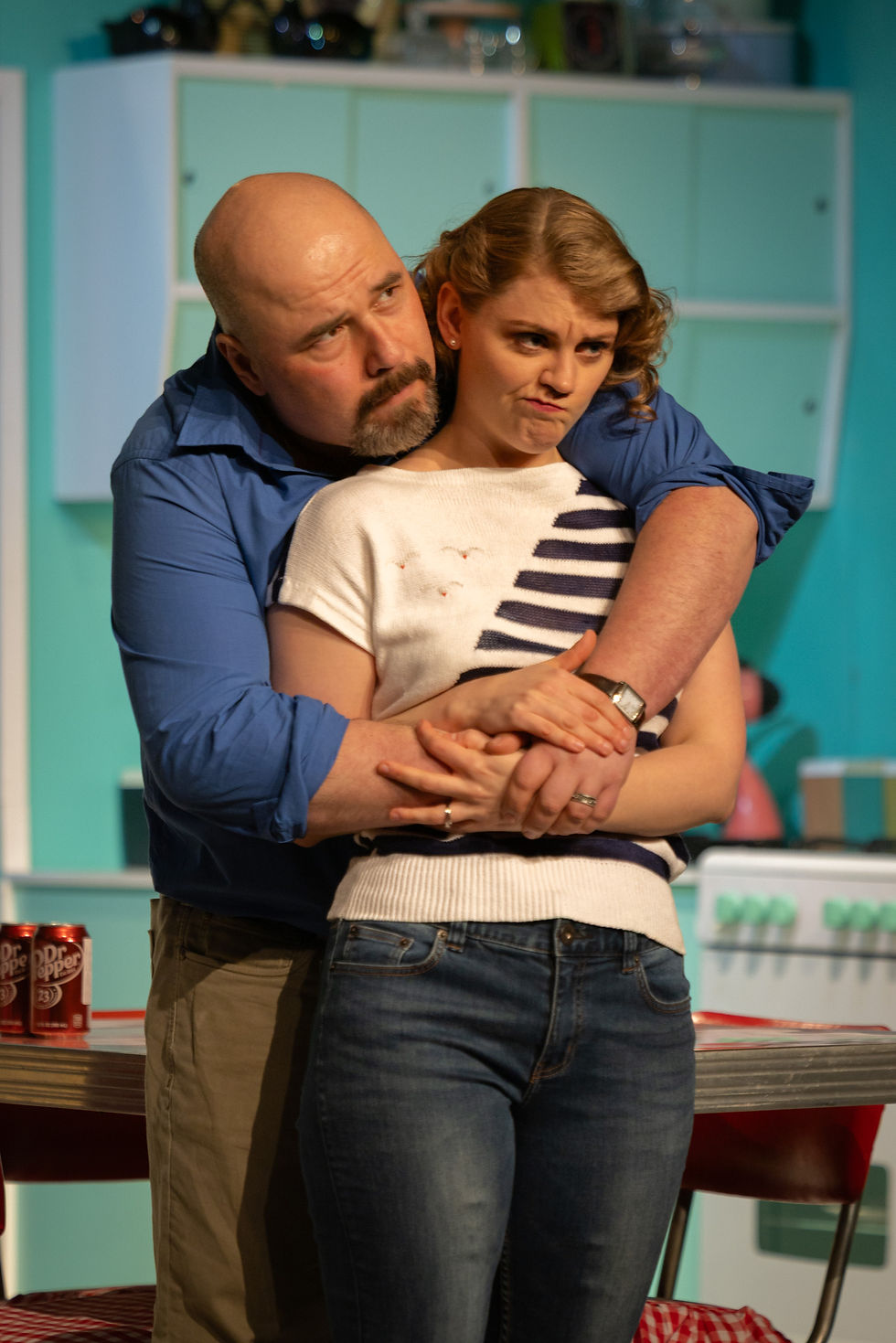
A well-placed flashback reveals that the arrangement was Judy’s idea, born from her love of a nostalgic 1950s fantasy (with the discrimination and restricted choices carefully edited out). As more details emerge, it becomes clear that she is also using that fantasy to escape modern work, uncomfortable feelings and difficult conversations. Lauren makes Judy’s growing desperation feel completely believable. Maintaining the masquerade becomes more compulsive, and every question starts to feel like an attack on the identity she has chosen.
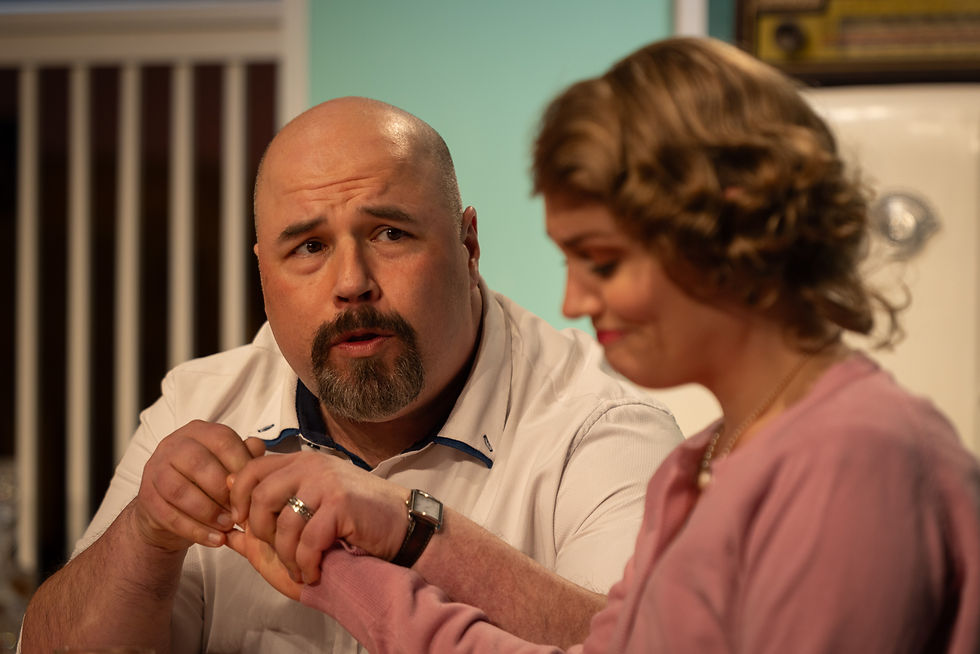
Michael Civitano gives Johnny an affable quality that suits the early sitcom styling. He plays him as a husband trying very hard to keep the peace, please his wife and hold their chosen lifestyle together, even as the pressure around money boils beneath. His blunt line, “How can you be tired? You don’t do anything,” drew an audible reaction from the audience, hitting with the sting of something blurted out in a heated argument that you immediately wish you could take back. His chemistry with Lauren makes their marriage as believable as a sitcom marriage can be, complete with paraded joy and delightful dysfunction.

At the performance I attended, director Martie Blanchett stepped into the role of Sylvia (Judy’s hippie mother), covering the role usually played by Linda Shapcott. Sylvia punctures the romantic mythology of the household from the moment she arrives. She has very little patience for her daughter’s cartoon version of the past, while Judy reacts to her prodding with the defensiveness of a teenager being told she does not know everything.
Blanchett’s major monologue is one of the production’s most powerful moments. Sylvia reminds Judy that the decade she adores was not a permanent swirl of pastels, patterns and domestic cuteness. Women had fewer choices, little independence and were expected to tolerate far more than Judy’s glossy version of history allows. Blanchett grounds the monologue in Sylvia’s concern for her daughter as she watches Judy willingly surrender choices that previous generations of women fought to gain.
“That’s what life was like for women in the ’50s. Fear."


Courtney Murrin is the master of saying a lot without uttering a word as Fran. She reacts to Judy’s performance with curiosity, concern and even a little delight at the tea, cake, gossip and marital drama unfolding around her. Fran’s relationship with Marcus offers a more modern marriage for comparison, though not necessarily a healthier one. Jamie Spence plays Marcus with the perfect level of unpleasantness - complete with roving eyes, faux charm and the self-assurance of someone who has never once questioned whether he might be the problem.
Liz Ball makes a strong impression as Alex, Johnny’s assertive new boss, despite having only a handful of scenes. She walks into their house, takes in the décor, and starts asking the burning questions we have all been quietly wondering. Liz gives Alex a confident, no-nonsense presence that bounces nicely off Judy’s highly managed hospitality. Her easy rapport with Michael also makes the “work wife” tension very clear, much to Judy’s discomfort.


The costume magic by Simone Behrendorff (and her fabulous team) sees Judy strut her stuff in one adorable getup after another, with the watermelon dress stealing the spotlight. Her evening cocktail gown paired with a fox fur wrap is so retro that even Alex quips, “I feel like I'm in Mad Men.” With petticoats, pantyhose, heels, pin curls, and neck scarves, Judy inhabits the woman she believes she needs to be. Madz O’Hare’s choreography lets her groove through her favourite decade with swing and jive moves. That style is no walk in the park, but the cast handles it well!
Sound by Brendan Dieckmann, Seven Yuenyang and Martie Blanchett, along with Doug Brimblecombe’s lighting, maintains the inviting domestic world even as life inside it becomes less comfortable. Some bouncy tunes keep the production transitions moving, with tracks like “It’s Got to Be Perfect” and “Working My Way Back to You” offering cheeky insights into the characters' state of mind.

Martie Blanchett’s direction enables their somewhat unnatural lifestyle to unfold with unexpected naturalness. The themes emerge through household routines, conversations and compromises that quickly stop seeming cute. Living without modern conveniences becomes less whimsical, frugality starts to look like deprivation, and self-sufficiency leaves Judy increasingly isolated. The play has plenty to say about the value of domestic work, but its strongest point is about choice and what happens when all that care travels in only one direction. It gives new weight to the advice in Judy’s 1949 household manual: “A good wife listens more than she speaks.”
The audience at this performance was wonderfully responsive (and there was plenty to react to!). Swich Up Productions has created a funny, clever and carefully detailed production that begins with happily ever after already in place, then explores what happens when the characters can no longer perform it. It certainly sparked plenty of discussion on the drive home. For one evening, I was happy to visit Judy’s retro world. And I was equally happy to return to my own, with my twenty-first-century rights intact.


Comments