


REVIEW: Jagged Little Pill - NAPA Ensemble

Jagged Little Pill
Presented by NAPA Ensemble at the National Academy of Performing Arts
Director, Set Design, Lighting Design: Hunter Wall
Musical Director: Laila Cheqer de Souza
Vocal Director: Jonathan Whitlow
Choreographer: Cooper Swain
Assistant Choreographer and Costumes: Kim Reynolds
Sound Design: John Taylor
Photography: David Reynolds
Jagged Little Pill contains strong themes and depictions relating to sexual assault, substance addiction, overdose and mental distress. Slight spoilers follow.
“I’m sane, but I’m overwhelmed. I’m lost, but I’m hopeful, baby.”
There it is. The anthem that speaks for an entire generation of people who are technically functioning and outwardly smiling, but secretly hanging on by a thread. It also speaks for every character in Jagged Little Pill.
Inspired by Alanis Morissette’s landmark 1995 album, with a Tony Award-winning book by Diablo Cody, Jagged Little Pill follows the Healy family: Mary Jane, a suburban super-mum hooked on painkillers; her emotionally absent husband, Steve; their golden-child son, Nick, buckling beneath the pressure to be perfect; and their adopted daughter, Frankie, refusing to play the role she's been cast in and fighting to be heard. Behind their annual Christmas letter sits a marriage stripped of intimacy, a fractured family, and a community more concerned with preserving appearances than confronting harm.

As the overture layers Alanis’ music and lyrics, the NAPA Ensemble cast emerges in a blaze of distressed denim and defiance, and the chills hit me instantly. Elevated above them, the band plays with the passion of an arena concert. This is alt-rock and theatre colliding at full throttle! You will find that the storyline takes on a lot: queer identity, gender fluidity, systemic racism within interracial adoption, dysfunctional marriage, sexual assault and drug addiction. In less capable hands, it could simply become a checklist of social issues. But here, they have assembled the perfect cast to depict the individuals behind these issues.
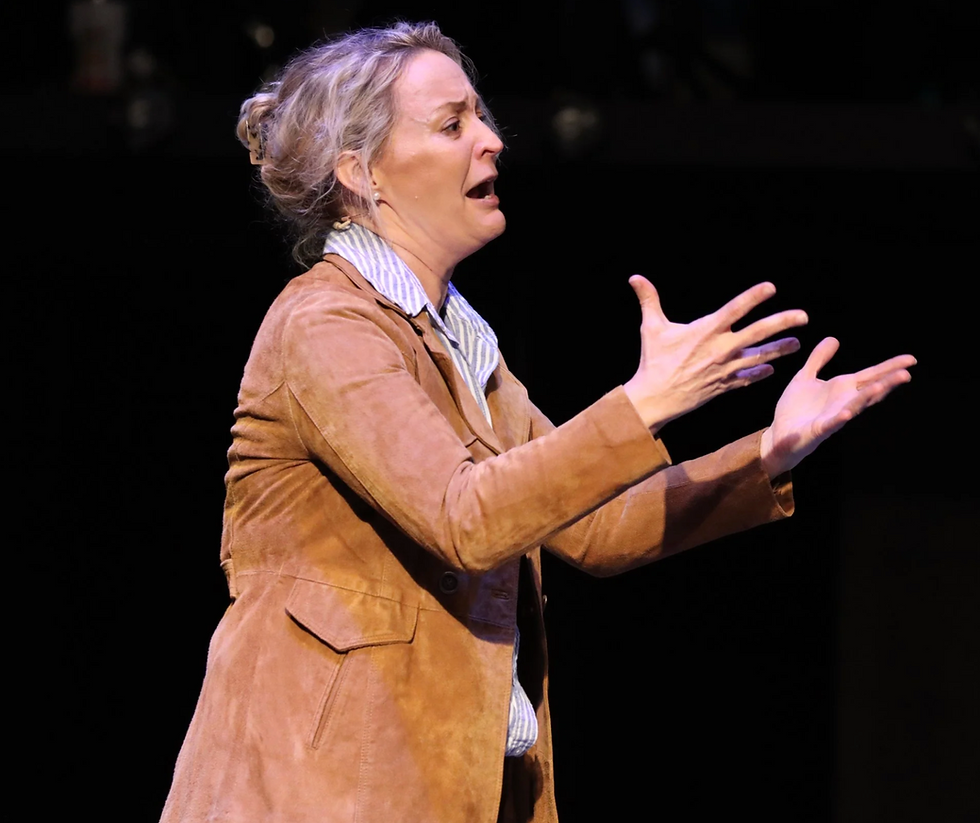
Caroline Taylor gives a formidable performance as Mary Jane, or MJ (get it?), a troubled mother who elicits both empathy and frustration. At first, she’s almost comically recognisable in her activewear, puffer jacket, and forced smile. Caroline makes the audience privy to the desperation that MJ keeps concealed from her husband, children and friends. It lives in her eyes, in the way she carries herself and in her frantic need to control everyone else because she cannot control herself.


“Smiling” is one of the production’s earliest triumphs (and has stayed in my mind ever since). MJ’s day unfolds in reverse, retracing her steps from the supermarket to the dealer, the pharmacist and the yoga class before returning to the moment she realises she’s run out of pills. This “anatomy of my crash” reveals the exhausting momentum behind her mantra: keep on smiling, keep on moving, can’t stand still. It plays like a moody ’90s music video, with the ensemble’s choral backing swelling beautifully around Caroline’s powerful voice.
She’s even more devastating in “Forgiven”, as MJ enters a church searching for relief and instead confronts all the skeletons in her closet. Caroline lifts the roof vocally, but it’s the fury beneath the prayer that makes the number so gripping. As MJ’s carefully buried trauma rises to the surface, I found myself getting misty-eyed (and my notes become progressively less legible from here).


Samantha Price shines as Frankie, a fiercely principled and impulsive teenager devoted to her causes, yet somewhat careless with Jo’s heart. “All I Really Want” immediately dives into the family conflict, fuelled by years of misalignment. Her Act Two explosion in “Unprodigal Daughter” is astonishing. As her frustration finally boils over, Samantha channels every ounce of Frankie’s angst and determination into the performance while the ensemble surges around her.
“Ironic” is reworked as a school writing assignment before giving way to a powerhouse duet between Frankie and Phoenix. Flynn Anderson gives Phoenix an enigmatic charm: he listens, encourages and makes Frankie feel seen in a way she rarely is at home. Yet his own family responsibilities are never too far from view.


Shilo Kwocksun gives Jo a dry humour that doubles as a defence mechanism, but their pain still slips through the cracks. Frankie is both Jo’s refuge and their greatest risk. When “You Oughta Know” arrives, all that restraint finally snaps. Shilo takes complete ownership of Morissette’s most famous song. With her killer voice, mounting rage, the band and the full force of the ensemble choreography, the result is absolutely massive. It’s the sound of humiliation and grief growing too large to contain. Every sensible theatre-going instinct told me to remain seated, but in my head, I was in the mosh pit!

“Hand in My Pocket”, led by Shilo, opens into some especially satisfying group harmonies, guided by vocal director Jonathan Whitlow. Later, “That I Would Be Good” unites Frankie, Jo and Phoenix in a stunning three-part vocal arrangement, with their voices blending into truly breathtaking harmonies. By that point, I was fully emotionally invested. I had stopped taking notes quite so neatly and started writing things like “WHYYY” in the margins.
“If you’re flawless, then you’ll win my love.”

Greyson Vaughn brings a quieter tension to Nick, carrying much of the character’s story in his physicality: hunched shoulders, a body folded inward and a face contorted as though the weight of expectation is physically pressing him down. When MJ tells him, “Sometimes I think you’re the only thing I’ve done right,” the apparent compliment lands like another responsibility he cannot afford to fail. Greyson’s solo “Perfect” gives voice to a boy who has learned that love is conditional upon achievement. Later, Greyson and Caroline meet in a series of brilliantly raw confrontations as Nick is forced to face his own complicity.

“Tell me when I’m going to feel normal again.”
Angelique Giuffre gives Bella an intensity that cuts through the production whenever she appears. Bella is mocked, doubted and reduced to an accusation, but Angelique keeps reclaiming her as a person. Her featured moments are vocally charged, with anger audible in the tremor of her voice. “Predator” is particularly harrowing. The choreography uses bedsheets, lifts and fractured movement to revisit the past without spelling it out too literally. Around Angelique, the lighting and shifting white flats create a nightmarish world, while an eerie operatic soprano line cuts through from above. Angelique and Caroline both give the material the weight and care it demands.


Jonathan Whitlow lets Steve’s emotional distance slowly crack open. The split staging of “So Unsexy” keeps their disconnection visually alive, while “Mary Jane” beautifully captures the grief of a husband realising how much the person beside him has concealed. In the marriage counselling scenes, Jonathan and Caroline capture how awkward and realistic it is when two people who have spent years dodging difficult conversations finally try to talk. “Not the Doctor” refuses the fantasy that one session can repair years of avoidance, but it allows them to begin speaking honestly. “Head over Feet” juxtaposes Frankie and Phoenix’s new connection with Steve and MJ’s faltering marriage, creating an epic four-part number that places two relationships at very different stages side by side.
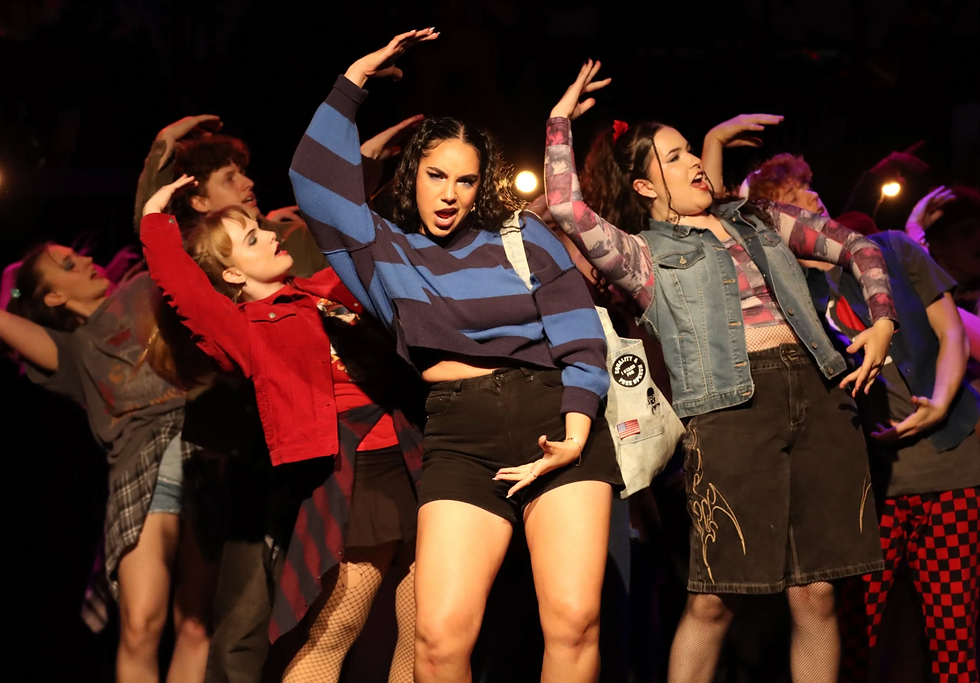
Hunter Wall directs with urgency. Nothing remains still for long: scenes bleed into songs, furniture shifts in plain sight and the ensemble circles the principals like persistent thoughts. That motion is central to Cooper Swain’s choreography. The dancers don’t simply appear for the musical numbers and disappear when the dialogue returns; they embody the urges, shame, temptation, memory and panic the characters cannot express aloud. The style is contemporary, muscular and appropriately jagged. Sharp angles give way to suspended tableaux as bodies climb, collapse and catch one another. The choreography demands enormous strength, precision and endurance. Somehow, they can all sing while doing it too!
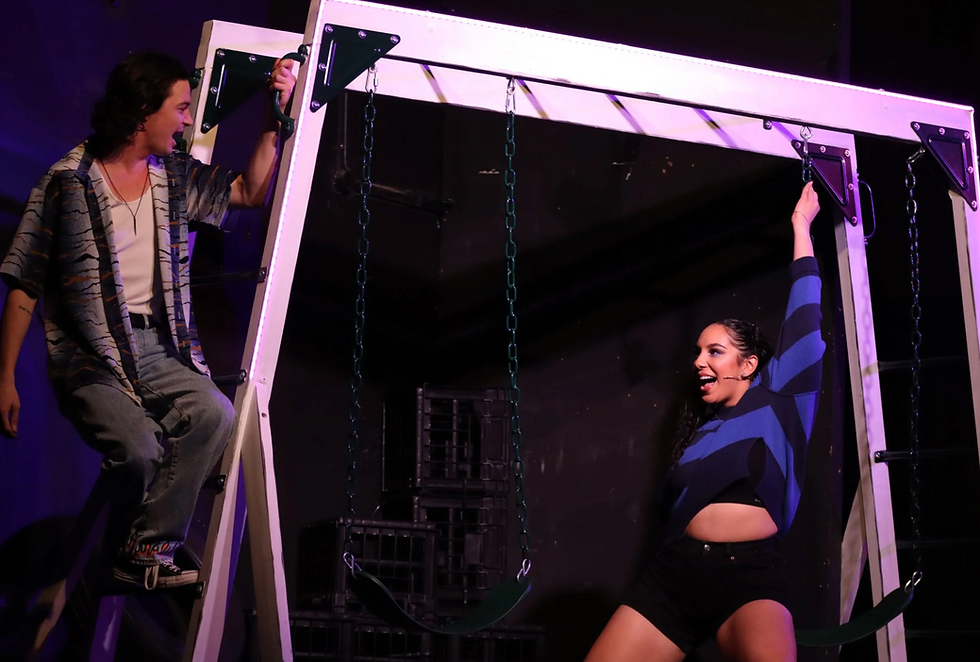
Hunter Wall’s set uses tall moveable flats to shape the space, support fluid transitions and create moments of theatrical magic as they conceal and reveal bodies. The raised stage offers strong sightlines from any seat. Plus, a full swing set becomes a playground, meeting place and structure to dangle from as relationships grow increasingly precarious. Hunter’s lighting guides the eye cleanly through the busy physical world, while an LED outline of a house frames the family at the centre of it all.

Under Laila Cheqer de Souza’s musical direction, the band drives the production with the force of a live rock concert. John Taylor’s sound design ensures the microphones remain perfectly clear against that power (By the way, it gets LOUD). Kim Reynolds’ costumes and hair design draw from grunge, punk and rock without trapping the show in one era. The ’90s influence is clear, but this remains a modern world of smartphones, screenshots and viral judgement.

The ensemble is essential to this world. At times, they are classmates, parents or protesters; elsewhere, they become a collective conscience, a physical manifestation of emotion or a swarm of voices pressing in on a character. I cannot name every ensemble member individually, but please know I saw you, applauded you and spent several numbers concerned about your necks (you were really throwing those things around!). Elysium Hipwood’s dance solo during “Uninvited” definitely deserves a shoutout, giving physical form to MJ’s collapse as the production grows heavier and louder around them both.
“You can’t undo what’s already been done.”
True, but the musical still asks what we do next. The rally sequence in “No” is the emotional peak. Its longer refrain asks the question much more directly: “What part of NO do you not understand?” Bella’s private trauma becomes public resistance. The voices build and the anger is no longer isolated inside one person. Everyone moves downstage, right into our faces, removing any comfortable distance between the audience and what is being said. I'm not ashamed to say that it had me in tears, along with what appeared to be nearly every other woman in the audience.

As the show moves towards “You Learn”, it offers bittersweet optimism rather than miraculous recovery. Relationships are not restored to their original forms; they are rebuilt with greater honesty, understanding and connection. Repeated hand gestures resembling signed language accompany the finale, giving the song a communal tenderness as though each lesson is being passed from one person to another.

Jagged Little Pill is a jukebox musical, yet it’s not a catalogue of Alanis Morissette hits strung between convenient plot points. The album was released on 13 June 1995, the same year I was born (so naturally, I am claiming a personal connection). I did not experience it as the cultural earthquake it was for an earlier generation, but its impact has travelled. The songs belong to these characters because Morissette’s writing already gives voice to everything they are struggling to say.

There are many more songs and snippets I have left unmentioned. You don't need to arrive as an Alanis Morissette fan... give this cast a couple of hours and they will take care of that. By the final bows, I felt wrung out, fired up, and deeply grateful to have been in the room. I certainly walked out ready to scream-sing the entire album on the drive home.
This is bold, confronting and beautifully controlled work from a cast with extraordinary potential. As my first NAPA production, it exceeded every expectation I had. I would see it again in a heartbeat, and frankly, every performance deserves a full house. For all its anger and noise, Jagged Little Pill lands on an obvious truth: it does not promise that everything can be fixed. It simply asks us to stop pretending nothing is wrong.


Comments