


REVIEW: Werewolf - Binge Culture, Brisbane Festival, Brisbane Powerhouse

Werewolf
Produced by: Binge Culture
Presented by: Brisbane Festival in association with Brisbane Powerhouse
Venue: Underground Theatre, Brisbane Powerhouse
Date attended: 24 September 2026
Devisers/Performers: Joel Baxendale, Stella Reid, Hannah Kelly
Dramaturg: Ralph Upton
Sound Designer: Oliver Devlin
Devisers: Karin McCracken and Freya Daly Sadgrove
Set and Lighting Designer: Lucas Neal
Technical Stage Manager/Operator: Marshall Rankin
Voice Artist: Moana Ete
Photography: Mouce Young, Lewis Ferris, and Vanessa Rushton
“Attention: Multiple new occurrences confirmed. Healthy citizens report to safehouses by sunset.”

A lycanthropy outbreak has begun. Brisbane is in lockdown! Binge Culture’s Werewolf drops its audience into a seven-day containment scenario overseen by three Kiwi wardens in charge of keeping everyone in the theatre alive. I'm not sure how to describe this one. It's kind of a ‘had to be there’ moment. Inspired by the social deduction game also known as Mafia, the show borrows its cycle of day, night, suspicion, misinformation, and hoping nobody eats you after lights-out. It feels like an escape room collided with a murder mystery and became immersive theatre.
The clever bit is that participation sounds much scarier than it is. Nobody is expected to suddenly invent a monologue about their childhood trauma or perform interpretive dance under pressure. Audience members receive Public Information instruction cards, jobs, props, and occasional things to say or do. Some participation is planted directly into the room through those instructions, while anything extra we throw at the performers is our own fault.

This production needs people willing to play, and the crowd at my performance understood the assignment. Suspicion spreads, information gets mangled, people volunteer opinions nobody asked for, and the safest course of action appears to be listening to the loudest person in the room. You know, civilisation.
That structure also creates an entertaining uncertainty around your fellow audience members. Is that person behaving strangely because their card told them to? Are they improvising? Are they a werewolf? Am I overthinking this because I have been issued a tinfoil hat?

Joel Baxendale, Stella Reid, and Hannah Kelly have the unenviable task of steering all this without making the steering visible. They hold onto the planned shape of the show while dealing with whatever nonsense comes flying back from the room, meeting ad-libs with quick wit without letting the containment scenario drop away.
Hannah Kelly is the funniest of the trio in my performance, finding dry reactions to the absurdity around her and knowing exactly how long to sit in a joke before moving on. Stella Reid becomes the default leader, the most reassuring presence of the three. Joel Baxendale is the suspicious one. He is irritating in precisely the way a man trapped in a bunker during a werewolf outbreak should be irritating: just questionable enough that you keep watching him.
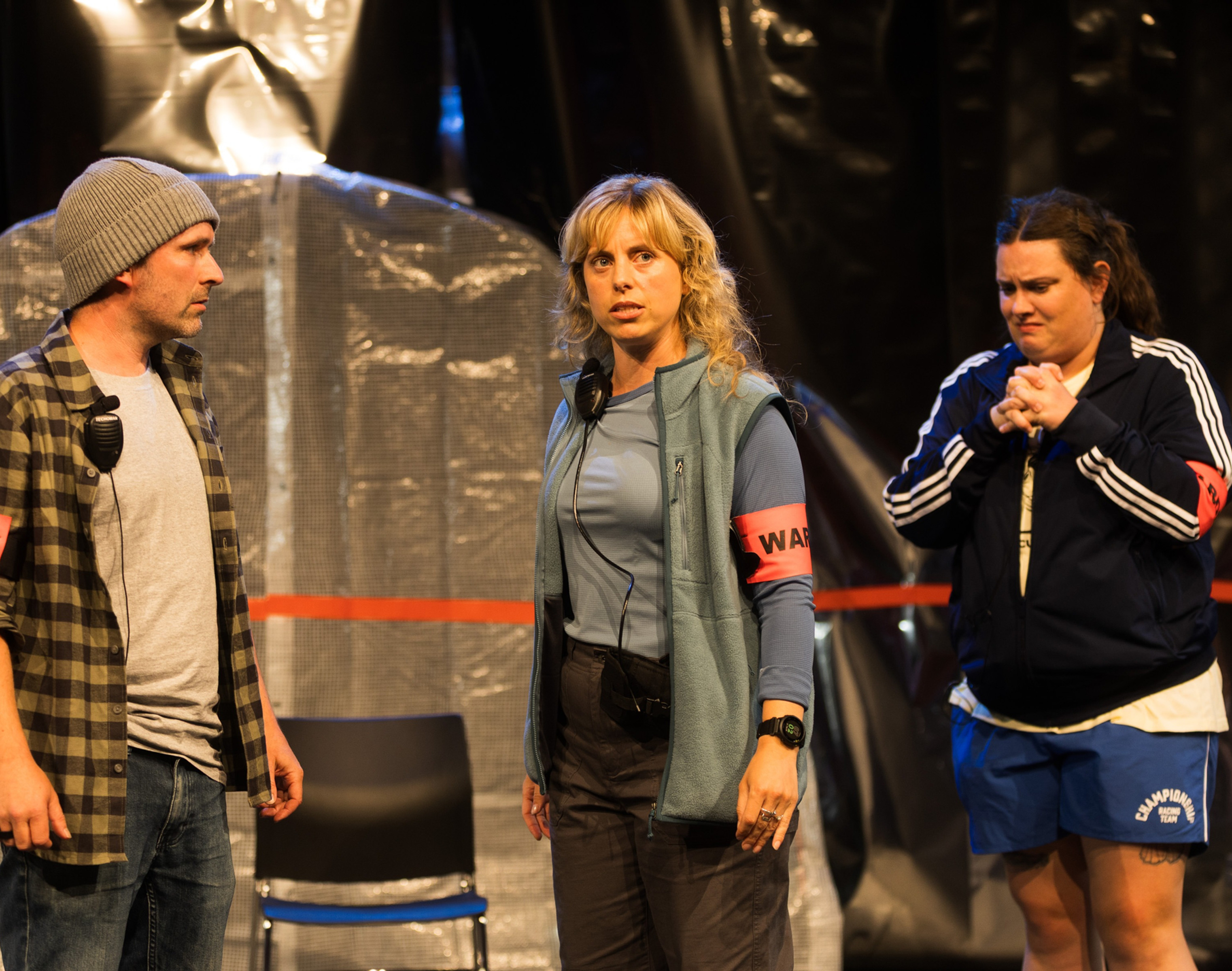
Together, they fall into a rhythm of bickering, damage control, and increasingly dubious crisis management. These are not sleek government operatives in tactical gear. They have fleece, flannelette, trackies, beanies, crocs, radios, and warden armbands, as though somebody has grabbed three people from Bunnings on a Saturday morning and informed them they are now responsible for national security.

Lucas Neal’s set has the same improvised quality. The safehouse is built from reflective black and silver sheeting, plastic screening, hazard tape, folding chairs, storage crates, work lights, and an old radio. It’s visually sparse, yet the technical world around it is doing a huge amount of work. A live camera feed keeps watch outside the safehouse. Radio broadcasts filter in. Lighting shifts alter how safe the room feels, and when night arrives, the production commits properly to darkness. These are full blackouts, including the emergency exit signs, and suddenly every tiny sound has teeth.

Oliver Devlin’s sound design has enormous fun with that loss of sight. Howls circle somewhere outside. People scream around you. Doors creak. Things go bump where you cannot see them. At points, it sounds like the opening of Michael Jackson’s Thriller, which is precisely where my brain goes when I'm sitting in pitch blackness waiting to be mauled by a fictional wolf.

The jump scares are ridiculous fun. They also demonstrate how little Werewolf needs to physically show us. Once the lights disappear, the safehouse expands inside your imagination. A sound from behind you becomes far more alarming when you have no idea who, or what, is responsible for it. Devlin, Neal, and operator Marshall Rankin manipulate that uncertainty with careful timing, bouncing the show between laughter and genuine tension without losing its homemade emergency-bunker aesthetic.
The production began development during New Zealand’s isolation in 2020, which makes its interest in containment, unreliable information, communal behaviour, and deciding whom to trust easy to recognise. Thankfully, Werewolf doesn’t turn into a lecture about misinformation. The ideas sit inside the game. We experience how quickly a room develops theories, backs the wrong person, follows questionable authority, or repeats something until it starts sounding credible.


And because the audience contributes so much, no two performances can be identical. That is also the show's biggest dependency. Werewolf wants a healthy crowd and, more importantly, a willing one. A half-empty room full of people determined not to participate would inevitably change its energy. General admission seating also means your experience varies depending on where you sit. The front row is definitely the full-contact zone, while anyone farther back should choose a seat with a decent view of the screen and live feed. So choose wisely. Also, there is a strict lockout. Don't be late. And hold your pee!
Werewolf is the sort of immersive theatre I can happily recommend to people who normally hear “audience participation” and begin planning an emergency exit. You are given enough structure to feel safe joining in, while Baxendale, Reid, and Kelly are quick enough to catch whatever extra chaos the room invents. Luckily, I thrive in a crisis.


Comments