


REVIEW: Brisbane - Ad Astra Theatre
Updated: Jul 6

Written by Matthew Ryan
Presented by Ad Astra
Director | Fiona Kennedy
Assistant Director, Set Design, Projections, Wigs | Stacie Hobbs
Stage Manager | Chloe Rose
Costume Design | Georgina Purdie
Lighting Design | Geoff Squires
Sound Design | Tommi Civili
Choreography | Nicholas Coubrough
I always find it hits differently when a story is set somewhere you know well. Brisbane isn’t just a backdrop here, it’s the TITLE and the heartbeat of the story.
We don’t often think of Brisbane as a “war story” setting, but it turns out, history was unfolding right here in our own backyard. The play is set in 1942 and is told by 14-year-old Danny, who has a head full of stories and a romanticised view of war. He idolises his older brother Frank, until reality crashes in with devastating force. When American troops arrive in Brisbane, Danny’s world begins to shift in ways he could never have imagined.


This coming-of-age tale is shaped by war, loss, and a reality Danny is unprepared for. The writing blends wartime realities with a distinctly Aussie perspective, where humour, resilience, and a touch of cheekiness coexist with heartbreak. The impact of combat loss hits sooner than I expected, shattering the family's illusion that Frank was somehow invincible. Under Fiona Kennedy’s direction, and Bailey Sprecak’s lively narration, the piece sustains a strong sense of momentum and brings a contemporary theatrical rhythm to the historical setting.
The Galaxy stage at Ad Astra Theatre is used in full, with a multi-level wooden set that captures both the intimacy of a family home and the expansiveness of memory. A simple armchair, lamp and radio ground us in the 40s era, while a bare tree silhouette, enhanced by projections, shifts us through different seasons and times of day.


This is definitely a performance-focused piece, and Bailey Sprecak gives Danny an endearing awkwardness. Portraying a slightly dweeby, imaginative 14-year-old who idolises his older brother, he brings a warmth and innocence to the role at first. But when Danny is confronted with the reality of death for the first time, there is a noticeable and unsettling character shift. His innocence fractures, leading to a gradual spiral into confusion, anger, and a desperate attempt to make sense of loss.

The relationship between Danny and Frank, played by Liam McMahon, is beautifully realised. Their dynamic is playful and supportive, with a natural sense of brotherly connection that makes Frank’s absence loom large over everything that follows. McMahon reappears as Andy, an American pilot who takes on the role of a surrogate brother figure.


The parents provide a realistic emotional anchor. Brent Dunner plays the quintessential gruff Aussie dad. Shaped by his own experiences and injuries from WWI, he quietly carries trauma while trying to keep busy with constant renovations on the Queenslander family home. Lisa Hickey delivers some of the most heartbreaking moments of the piece. Her motherly grief manifests in denial and dissociation, clinging to the idea that her son is still alive. It’s uncomfortable, raw, and deeply affecting to watch.

Hannah Sisson brings a gentle warmth to Rose, offering moments of calm amidst the chaos unfolding around the family. Her relationship with Danny carries an added complexity, as his closeness to her becomes entangled with his longing to take his brother’s place.

Aimee Duroux as Patty is the standout performer for me. She adds a completely different energy as Danny’s ever-present and exasperating friend. Wearing a leg brace and constantly on the receiving end of cruel labels, Patty has built a tough exterior, armed with biting humour and brash language as a defence mechanism. Her sharp tongue and fiery presence bring both levity and edge, particularly in the way she pushes back against how she’s perceived by others, while still revealing glimpses of vulnerability beneath.

The remaining actors shift between roles such as brash American soldiers, wary locals, schoolyard bullies, and historical figures, showing strong versatility across the ensemble. Jay Koloi’s voice work in the newsreel montage is a standout moment, with impressive vocal control and characterisation. Jack Winrow’s dry humour is particularly notable as he takes on multiple roles including Winston Churchill and General Monash. He and Mike Escober both stand out for their ease on stage, bringing a natural, assure quality to each moment. Natasha McDonald is particularly notable as the leader of the cricket boy bullies.

One of the more interesting threads throughout the show is the tension between Australians and the arriving American troops. The contrast is often played for laughs, especially in the exaggerated reactions of Brisbane women swooning over the “Yankies”, while local men bristle with resentment. Beneath that humour, however, is a genuine exploration of cultural friction and shifting social dynamics.
As Danny’s journey continues, the story takes a darker turn. His attempts to step into his brother’s place, to support his mother’s delusions, and to connect with an American soldier who physically resembles Frank all build toward an identity crisis. The escalation into impulsive anger and violence is intentionally jarring.


The production also leans into its setting in subtle yet effective ways. There are nods to Brisbane’s history and locations, including its reputation for danger in certain areas. Even the pre-show atmosphere contributes, with swing dancers performing in the courtyard in period costume before reappearing during the Cloudland scene (not the club in the Valley). The lighting design is also very effective, using colour and spotlights to clearly define and split scenes, while the sound design is abrupt in a way that deliberately jars the audience. Costumes and wigs feel authentically of the era, like they could have been pulled straight from 1942… aside from that questionable moustache (sorry Jack).

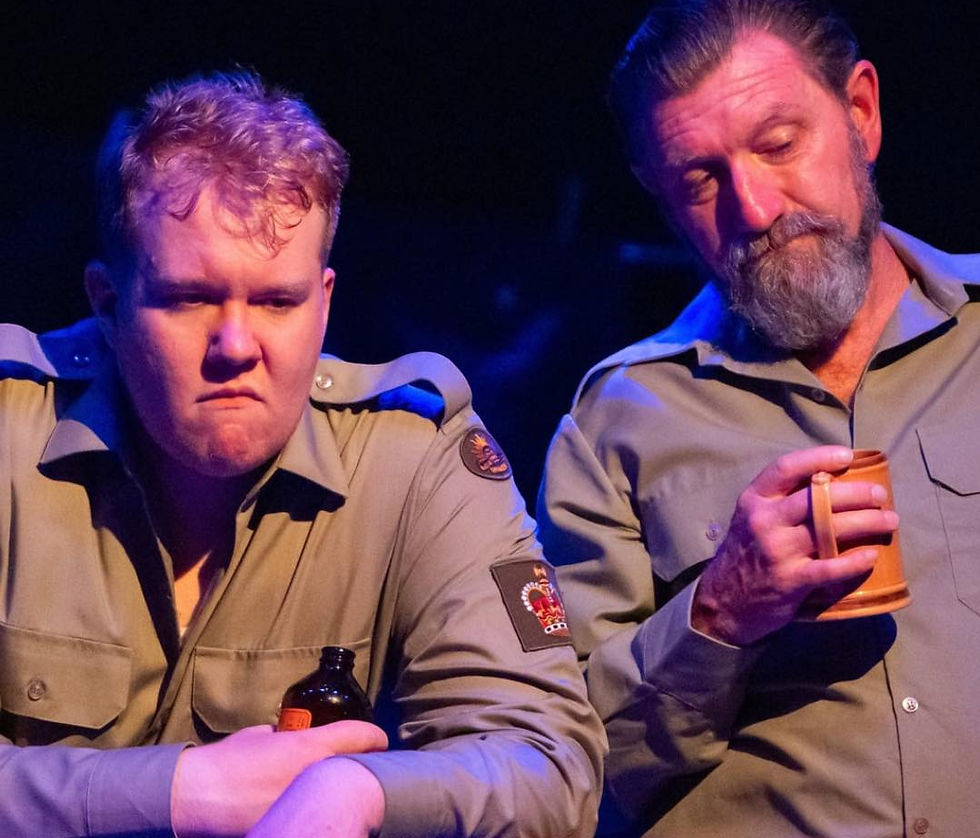
At its core, this is a story about the ripple effects of war. Not just on the battlefield, but within families, communities, and young people forced to grow up too quickly. It explores masculinity across cultures, women’s roles during wartime, the tension between civilians and soldiers, and the emotional toll of sudden loss, both literal and psychological, and how that trauma manifests over time.

While the performances are consistently strong, the script didn’t fully resonate with me on a personal level. At times, the narration and sound design become quite loud and frantic, making some lines difficult to catch, particularly in group sequences. It’s a small but noticeable barrier in an otherwise engaging production. That said, the cast’s commitment is undeniable, and there is plenty to appreciate here, particularly for audiences interested in Brisbane’s history and wartime storytelling. This is a thoughtful, locally grounded piece that blends humour and heartbreak, offering a perspective on WWII that is extremely close to home.


Comments