


REVIEW: Gems - L.A. Dance Project, Brisbane Festival
Updated: Sep 8, 2025
L.A. Dance Project | Benjamin Millepied

Presented by Brisbane Festival, Tourism and Events Queensland, and Brisbane Economic Development Agency, in association with QPAC
4 – 7 September, Playhouse Theatre
Before we even set foot inside QPAC, Brisbane Festival had us moving to the beat. A welcome procession: drumline pounding, trumpeters gleaming, performers in hot-pink bejewelled costumes, marched the crowd across the Neville Bonner bridge from Queen’s Wharf into the theatre. It was theatrical pageantry at its best, setting the stage for what was to come: Gems, Benjamin Millepied’s contemporary ballet trilogy, performed in full for the first time anywhere in the world.

Gems reimagines George Balanchine’s legendary 1967 Jewels for a new era, drawing on the same inspiration of Van Cleef & Arpels’ history of dance partnerships, but speaking in Millepied’s distinctly modern vocabulary. Each chapter: Reflections (Rubies), Hearts & Arrows (Diamonds), and On the Other Side (Emeralds), was a different jewel cut, a new way of refracting light through bodies, music, and visual art.
Now, let me be clear: I’m no dance scholar and I don’t pretend to understand every avant-garde choreographic choice. What I can tell you is how it felt.

Act One: Reflections
On a painted red-and-white floor, Barbara Kruger’s word art looming behind: first “Stay,” later dropping to “Go.” Pianist Tony Bai wrestled with David Lang’s minimalist score, music so fractured it honestly sounded like my cat walking across my piano, and somehow the dancers matched every offbeat step. The choreography switched from quick, jagged movements of Courtney Conovan and Clay Koonar to the more lyrical connections of Daphne Fernberger and Noah Wang, their gaze locked as if tethered by invisible thread. How Millepied even managed to choreograph to this score I’ll never understand, but the result was endlessly inventive. You will never guess their next move, and that was the case with both the movement and the music in Act 1.


Shu Kinouchi bounded around the stage in a solo that was equal parts rabbit-like joy and sheer stamina. At one point Shu and Noah slid into a floorwork sequence performed in complete silence… deliberately awkward to witness, but riveting. The costumes of grey with flashes of red trim, loose fabric, hair undone, were striking against the bold backdrop. In contemporary ballet, I’ve learned to expect the unexpected, and Reflections absolutely delivered that.
Act Two: Hearts & Arrows

The curtain rose on exposed light rigs and a new sense of urgency. From the first note, Hope Spears and Clay Koonar led with fierce precision, joined by the rest of the ensemble in relentless, kinetic streams of movement. This act was accompanied live by Camerata performing Philip Glass’s propulsive string quartet right in front of us. Their sound was so immediate it felt like a second set of dancers.
Audrey Sides’ central number stood out, her falls and recoveries framed beautifully by the shifting lights and the ensemble physically supporting each other back to standing. Meanwhile, Tom Guilbaud and Robert Hoffer seemed to defy gravity, their jumps reaching dizzying heights. The choreography was so quick, so relentless, that I felt I had to glue my eyes open for fear of missing a single detail (as Aerosmith would say, “I don’t wanna miss a thing”).

At one point the wings and back wall lifted to reveal the bare bones of the Playhouse Theatre itself. It felt strangely voyeuristic, like peeking behind the jewel’s polished surface. The interplay of light and shadow was exquisite, dancers vanishing and re-emerging as though refracted beams within the diamond itself.

Act Three: On the Other Side
The final act returned to piano: more Philip Glass, more fiendishly difficult fingerwork for Tony Bai, who never once broke focus even as he checked Courtney Conovan’s every step during her solo. This was Millepied at his most lyrical, painting sweeping arcs of joy across Mark Bradford’s painted canvas backdrop. I was a big fan of this set design, as well as the choreography in this act. Not super sold on the costumes, but I did like how each one was unique, like a jewel is.
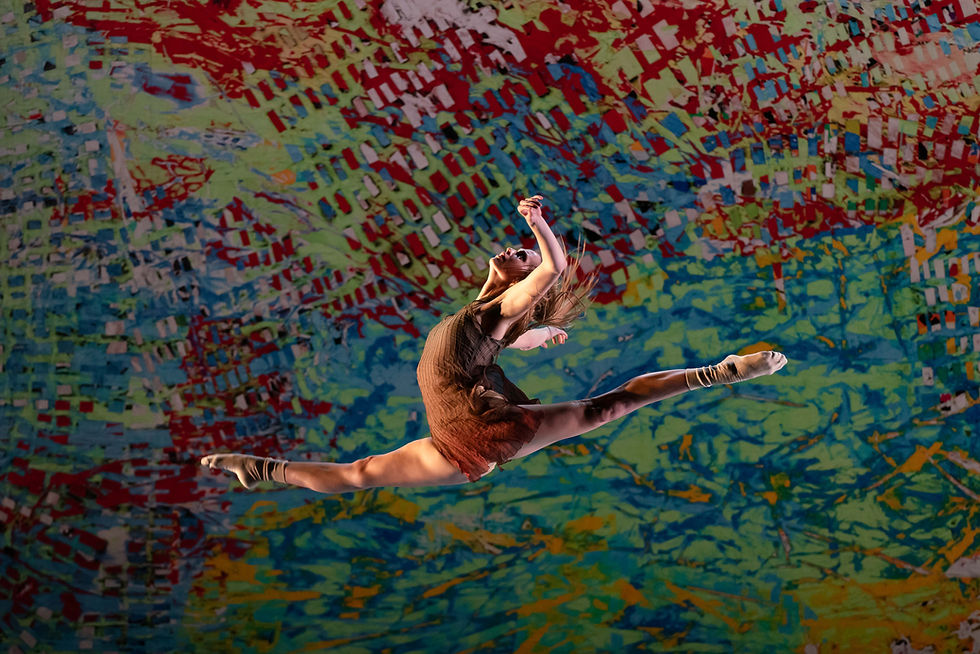

Here, we saw some of the most emotionally resonant duets of the night. Robert Hoffer and Tom Guilbaud’s pas de deux was a rare treat: two masc. dancers in seamless counterpoint, strength yielding to fluidity. Later, Daphne Fernberger and Courtney Conovan delivered an intense duet, their lifts and balances set against Glass’s furious piano. Daphne and Shu’s endless lifts and lightning-fast catches were so smooth, I half-joked to myself their “lift call” must last longer than rehearsal! Courtney’s solo, framed by beautiful tableaus of the rest of the dancers lit around her, was another highlight. I found that Hope, Daphne, and Shu danced with SUCH pure joy, I could feel it pulsating from them. Everyone else clearly danced with a huge passion too, but those three really made an impression.

Final thoughts
With two intermissions, this show clocked in at just over two and a half hours. That’s a lot of dancing! The stamina required was staggering: dancers and musicians alike pouring themselves into every phrase. And Brisbane audiences responded in kind, erupting in applause after each act.
Across three acts, Millepied took us from fractured longing, to communal urgency, to lyrical resolution…. each a jewel in its own right, and together a glittering triptych. It’s not every day that Brisbane plays host to a world premiere of this calibre, and it truly felt like a once-in-a-lifetime performance. And even if, like me, you’re quite daft when it comes to dance… the sheer spectacle of the daring lifts, the live music, the athleticism, and artistry was enough to sweep anyone along.
Photography by Jade Ellis, Laurent Philippe, Rose Eichenbaum


Comments