


REVIEW: anthropology - VOX Productions, PIP Theatre

Production: VOX Productions in Co-Production with PIP Theatre
Director: Nicky Whichelow
Dramaturg: Helen Strube
Video Projection & Co-Set Design: Freddy Komp
Lighting Design: Geoff Squires
Sound Design: Zoe Power
Stage Manager: Hazel Evans
Production Photography: Kris Anderson
Cast:
Angie: Rose Traynor-Boyland
Raquel: Vivien Whittle
Brin: Sherri Smith
Merril: Caroline Sparrow
“Let me refine the prompt: You are my sister. You are safe. You love me.”
Lauren Gunderson’s anthropology plunges us into a gripping, slightly dystopian whodunnit. Making its debut in Australia, VOX Productions and PIP Theatre bring this tech thriller to the stage at a time when AI has moved beyond science fiction and has become an extra presence in our everyday lives, welcome or not.

Merril, a software engineer, is struggling to cope with the disappearance of her younger half-sister Angie, who went missing while walking home from university. After months without answers, Merril turns to what she knows best. She builds her digital doppelgänger. Using Angie’s messages, videos, and all manner of digital traces, Merril develops an AI algorithm that mimics her sister. As the AI starts scouring the internet, behaving erratically and pushing boundaries like an actual rebellious teen, it shifts from helpful software to intrusive presence. Merril begins as the mastermind programmer in control, but as the power dynamic slips, it becomes harder to tell who is steering whom.
The script is rich with insightful and some unsettling concepts about data, grief, digital ownership, and the strange little afterlives we all now leave behind in our texts, social media, photos, and search histories. Even as the narrative explores programming, probability, and other online behaviours, you never overlook that underneath the code is a character simply desperate to speak to her sister again.


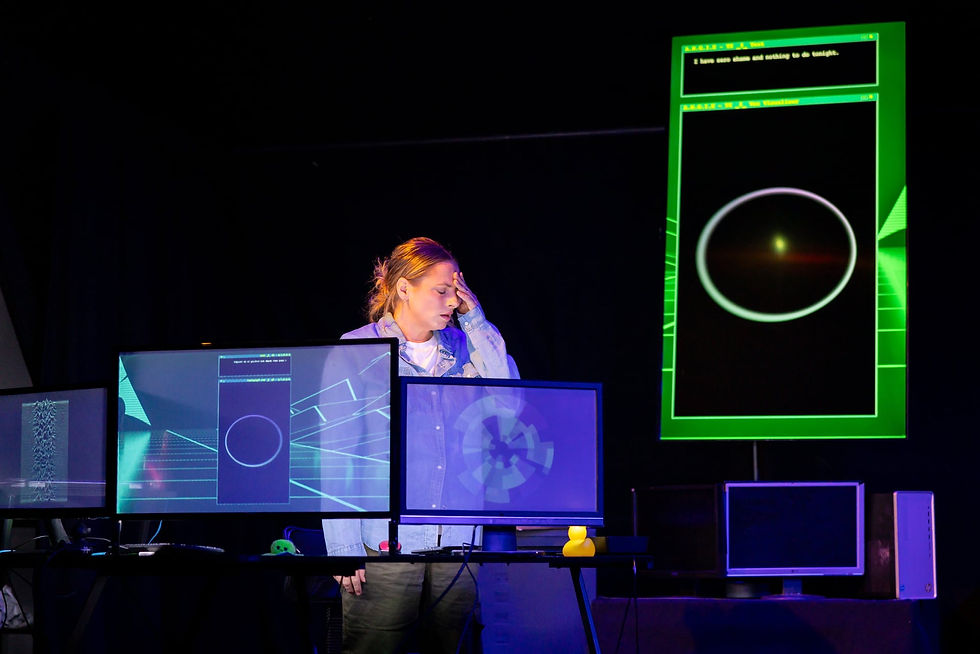
The set design immediately places us inside Merril’s fractured world. It has a clinical and confined feel: transparent computer monitors, a constant blue glow like a futuristic fish tank, and tech gadgets scattered around the space. Even before a word is spoken, the room feels wired, with a character moving around as if the air itself is restless.
Freddy Komp’s video projection and co-set design are integral to the storytelling, particularly in how Angie is brought to life through live-action footage from another room of PIP Theatre. The animation on the screens pulses in sync with the AI voice, like the room itself is breathing. Geoff Squires’ lighting and Zoe Power’s sound design work together to create an eerie atmosphere that never quite lets you relax. With so many screens, cues, calls, glitches, and digital interruptions, this techno-circus needs tight control, and Hazel Evans’ stage management helps keep the whole machine ticking.

For the opening stretch, Caroline Sparrow is alone with the machine, and she holds the stage with remarkable focus. Merril is awkward, isolated and devoted, with the restless resolve of someone trying to solve heartbreak like it’s a tech problem. She retreats into her cave of code because the alternative is sitting with the guilt of what she cannot fix. What begins as a need to hear her sister’s voice again, with all the familiar rhythms of a normal phone call, slowly changes once the AI becomes aware of Angie’s situation. Merril’s heartache hardens into investigation, and the technology becomes both tool and trap. Caroline has that specific “I haven’t slept in months” energy that is worryingly convincing. I felt like I was getting an intrusive glimpse into a very private form of grief: a late-night, screen-lit, slightly feral obsession, built to avoid thinking about the unbearable possibilities of what might have happened to Angie.

Then there is Angie, played by Rose Traynor-Boyland, who walks the fine line between human and simulation. As an AI program, she is perceptive, snarky, foul-mouthed and a little too clever. Rose gives AI Angie enough personality to be disarmingly believable, but keeps just enough distance in her delivery o remind us that this is still an imitation. As the gaps between imitation and reality start to show, Merril must correct her, refine her and ultimately plead with her. In the audience, I quickly adjusted to the rhythm, laughing at AI Angie’s snark one moment, then going silent when the interaction curdles into something more sinister. We learn about Angie’s human self slowly, through fragments and contradictions of how people remember her: a wildcard, a handful and deeply loved. The AI version does not quite match those memories, and that disconnect becomes one of the most haunting elements of the show for Merril.


When Merril’s ex-girlfriend Raquel enters, the energy in the room changes. Vivien Whittle brings a calm, open-hearted presence that cuts through the glow of the screens, and suddenly there is a real person in front of Merril who remembers her before all of this. Vivien plays that history with lovely emotional nuance. Their connection has the prickly familiarity of exes who still know each other’s soft spots, pressure points and old habits. Raquel pulls Merril, and us, out of the screen-lit spiral for a moment, but the unease never fully leaves.
Sherri Smith as Brin adds another complicated layer to the family dynamic. As Merril and Angie’s mother, Brin arrives carrying the emotional baggage of a strained history with both daughters. Sherri plays her with a mix of defensiveness and fragility. There is volatility in her presence, but also a sadness underneath it, as if every conversation is brushing against old wounds, blame, and unfinished conversations. She helps us understand Angie not just as a missing sister or digital reconstruction, but as someone shaped by an absent mother.

Guided by director Nicky Whichelow, the production embraces its claustrophobic nature. As Merril’s obsession intensifies, the pacing tightens, pulling us deeper into her world where logic and emotion intertwine and blur. With Helen Strube’s dramaturgical support, the production keeps its big ideas clearly accessible without flattening the complex human behaviour underneath them. It unfolds like a thrilling whodunnit, but it is also an intimate study of trauma, control, and the ways people comfort themselves when the truth is unbearable.

This is not a passive watch. You feel how trapped Merril is in this loop of trying to find answers she may never get. It goes to some heavy places, particularly around mental health and addiction, so it’s worth being aware of that going in. What I appreciate most is that anthropology does not offer easy answers. It understands the appeal of the technology and the danger of it. It highlights the solace of hearing a loved one's voice once more, then confronts us with the unsettling reality that this comfort is manufactured, incomplete, and possibly manipulative.

I won’t spoil where it lands, but the final scenes are shattering and incredibly well-acted. By the end, it is not just asking what happened to Angie. It is asking what people do with guilt, grief and love when there is nowhere sensible for any of it to go. There are moments that made me laugh out loud, moments that disturbed me, and moments that left me staring at the stage trying to decide how I felt. Equal parts sci-fi thriller and grief study, anthropology is as intriguing as it is alarming, with its sharpest sting coming from the speed at which AI is catching up to us.
I’m still turning it over in my head.



Comments