


REVIEW: Big Fish - Spotlight Theatrical Company
Big Fish The Musical

Presented by: Spotlight Theatrical Company
Book by: John August Music and Lyrics: Andrew Lippa
Based on: The novel by Daniel Wallace and the motion picture screenplay by John August
Date Attended: 2 August 2026
Director: Nathan French
Vocal Director: Taylor Holmes
Choreographer: Jo De Goldi
Stage Manager: Eliza Taylor
Set Design: Jeff Butterworth and Clay English
Sound: Caed Lawson
Lighting: Ariana Sinner and LJ Jones
Costumes: Pina Crisafulli Omeros and team
Photography: Vargo Studios
“Be the hero of your story.”
This Tim Burton film is now a musical. Yes, really. Based on Daniel Wallace’s novel and John August’s screenplay for the 2003 film, Big Fish follows Edward Bloom, a travelling salesman who loves turning his memories into epic adventures. His life is like a grab bag of tall tales, featuring a witch, a mermaid, a giant, a werewolf, and his extended family of circus performers.
His adult son, Will, has grown frustrated with these tales. As he prepares to become a father himself, he wants to know Edward's true self beneath all the exaggeration. When Edward becomes seriously ill, Will begins investigating his past, hoping to separate fact from fiction before it’s too late. All the while, Edward sticks to his signature style (mixing myths, life lessons, and always casting himself as the hero).
Director Nathan French embraces the musical’s two worlds, moving between domestic family tension and the circus inside Edward’s head. There's a lot going on, and anyone unfamiliar with the story may find themselves scratching their head, wondering if they’ve time-travelled to another decade or stumbled into a parallel universe.

The set doesn’t attempt to build each place Edward remembers. Instead, Jeff Butterworth and Clay English give him one enormous glowing doorway and let his imagination do the rest. The slatted arch rises above a timber stage, pier, and waterway. Ariana Sinner and LJ Jones use it almost like a mood ring, shifting its colour to become whatever the story needs at the time without requiring the production to stop for constant scene changes.
Smaller set pieces pop up whenever Edward’s imagination requires reinforcements. “Closer to Her” rolls out the circus gear, a human cannonball, and an elephant’s rear end. The bed becomes another portal into his stories, with characters emerging as though Edward has been storing half the ensemble inside his subconscious (or his mind has finally run out of storage space). It’s a fun reveal, although the performers crawling offstage were visible afterwards. We saw you there, gang! With haze drifting across the floor, fish flying overhead, and a crystal ball glowing ominously, the whole design evokes the fantasy of a bedtime story.


Clay English has a lot to carry as Edward Bloom, playing him through high school, courtship, parenthood, years on the road, and the final chapter of his life. He is rarely away from centre stage, and Andrew Lippa’s score keeps tossing songs at him like confetti. “Be the Hero” lays out Edward’s philosophy early. Life is an adventure, obstacles are there to be conquered, and there’s always another dragon to fight. The epic “Out There on the Road” keeps that momentum going as he befriends Karl the Giant and leaves his small town behind. English has confidence as a storyteller and clearly understands Edward’s appetite for attention.
Where I struggled was with the musical asking the same performer to play Edward across so many decades. The film separates young and older Edward, and I thought that approach would have helped here too. It would create a clearer shift between the larger-than-life young man Sandra falls for and the older father Will is struggling to understand. But I do understand that these are Edward’s recollections as he remembers them, rather than exact recreations of a moment in time.

Still, English handles the youthful romantic material well vocally, particularly “Time Stops” and “Daffodils,” where his gorgeous voice does plenty of wooing. “Daffodils” is also one of the production’s prettiest pieces of stage magic. The scenic design suddenly seems to bloom with them, as daffodils pop up into the water, climb the walls, and spread across the projected backdrop until Sandra is surrounded by Edward’s grand gesture.
English gets to show plenty across the evening, from strong vocals to tap dancing and the stamina required to carry so much of the show. For me, though, his acting was strongest once Edward was opposite Xavier O’Brien as adult Will. “What’s Next” is a highlight, with father and son finally meeting on the same emotional ground and writing Edward’s last story together in real time. “How It Ends” then gives English his big emotional release, weeping and singing his heart out as Edward’s bravado and showmanship finally fall away.

Xavier O’Brien gives Will a solid reality check against his father’s lifelong one-man show. He starts the show as a nervous groom, asking Edward to please make it through the wedding without turning the whole thing into another me-party. That request goes about as well as you’d expect. O’Brien makes Will’s resentment easy to understand without turning him into the antagonist in his father's life (at least until “The Showdown”). Edward was frequently absent during Will’s childhood, and when he was around, Will would never quite tell whether he was hearing actual family history or another engineered fantasy version of it. He has the exhausted air of a man who has heard the same fish story at one family gathering too many.
Vocally, O’Brien has a pure, polished sound. “Stranger” is an early highlight, as Will sings to his unborn son about barely knowing his own father. His later confrontation with Edward in “The Showdown” is one of the production’s more outlandish sequences. With Western costumes, heightened staging, and the ensemble rallying around them, father and son are finally placed inside the same story, only this time on opposite sides.


Dana Sandry brings a lovely maternal steadiness to Sandra Bloom, caught between two men who love each other but have no idea how to speak the same language. “Two Men in My Life” places her right at the emotional centre of the family, while “I Don’t Need a Roof” gives Sandry her strongest character moment. She keeps the delivery tender and controlled, letting the anticipatory grief arrive through the beauty of the song.

Hannah Martin is lovely as Josephine, bringing a softness to the role without fading into the background. She listens to Edward in a way Will no longer can, more interested in what his stories might reveal than in proving whether they’re true. Martin plays that openness with an observant quality rather than naïvety. Her presence becomes a welcome calming influence within the Bloom family.

At the performance I attended, Jordi Bridgman played Young Will and built an endearing relationship with Edward through the bedtime-story scenes. Martina French makes a strong impression as the Witch, strutting in with a killer costume and a booming voice that fills the room. Daniel Carson is an immediate visual hit as Karl the Giant, towering on stilts beneath oversized layers and dreadlocks. Carson also gets some lovely dry humour out of Karl, while the friendship lets us see one of Edward’s more appealing traits: he has a soft spot for people who don’t quite fit the mould.
Nathan Skaines dons the towering top hat as Ringmaster Calloway. “Closer to Her” transforms the stage into a wild spectacle of hoops, acrobatics, a unicycle, and all sorts of circus shenanigans while Edward tries to earn information about Sandra. Is it an epic love story or just a romantic stalking? You decide! Meanwhile, Jennifer Clark delivers a powerful punch as Edward's first girlfriend, Jenny Hill, especially when she confesses to Edward that she's been “drowning since he left.” For once, one of his tales is being told by someone who has had to live with the aftermath.

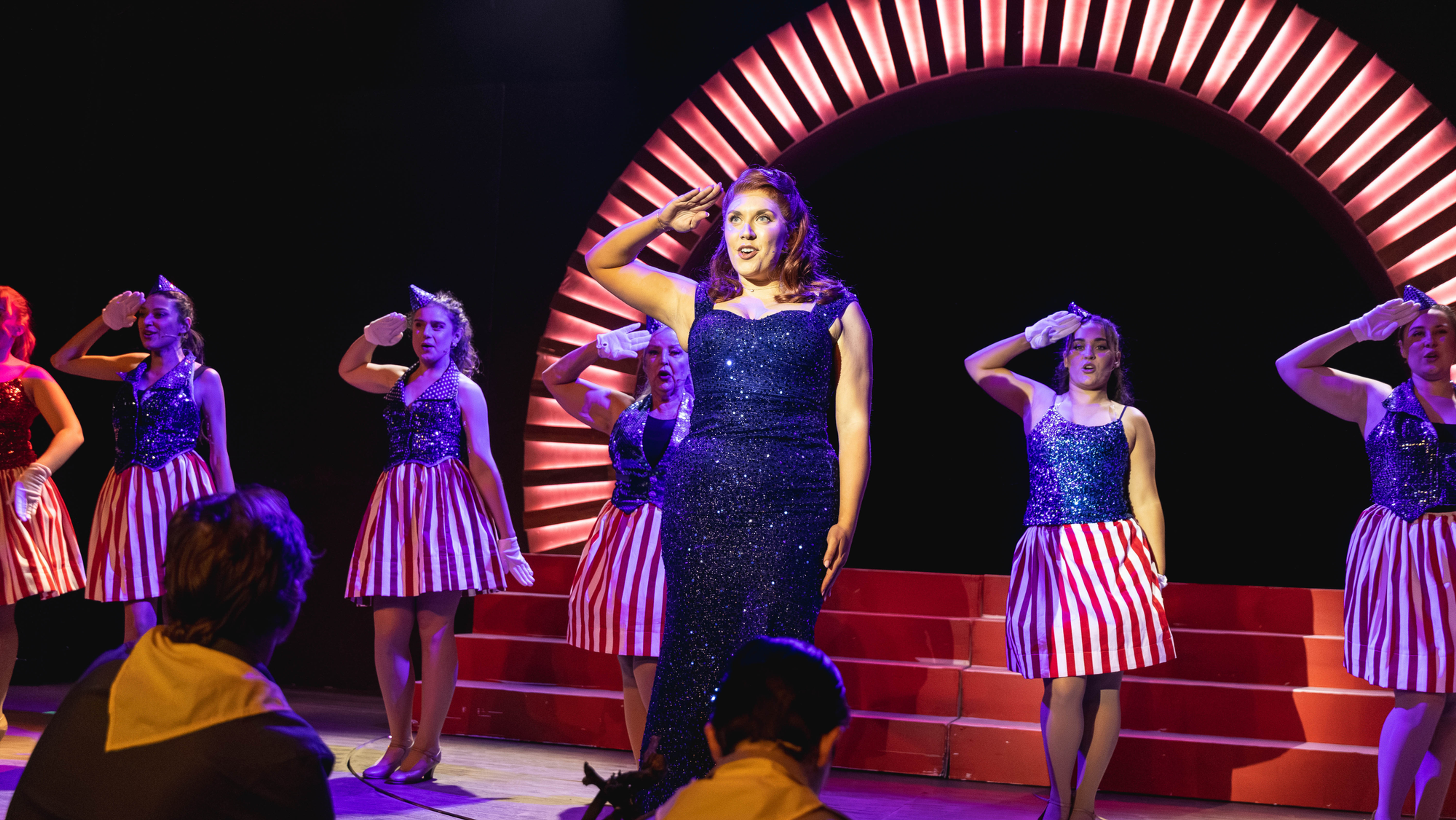
Jo De Goldi’s choreography makes good use of a musical that isn’t especially dance-heavy. “Red, White and True” brings tap onto the wooden stage with considerable volume. The ensemble brought colour and momentum whenever they appeared. A few moments fell into noticeable pockets of dead space beneath the underscoring.

Taylor Holmes’ vocal direction produces secure ensemble work and consistent delivery from the principal cast. “Stranger,” “I Don’t Need a Roof,” and “How It Ends” made the strongest impression on me, largely because the characters speak with such emotional directness. Caed Lawson’s sound design gives the production some real scale, although the music does drown out the dialogue here and there. Visually, the costumes have plenty to play with too, shifting from everyday family life into sparkling dresses, Americana stripes, circus outfits, and storybook looks.

The second half reveals a much sadder musical underneath all the colour. Illness starts creeping into the circus, and Edward and Will’s relationship becomes the real focus. While I didn’t connect with the themes of fatherhood as some audiences probably will, I could still see the heart of what the show was saying. “What’s Next” is where that heart lands best for me, as Will finally stops dismantling his father’s stories and helps him create one last adventure instead.
Edward uses his stories to make sense of his life, express his love for his family, and shape the narrative he wishes to leave behind. Spotlight Theatrical Company presents Big Fish with visual scale, inventive stagecraft, and committed performances. Audiences fond of the film, Andrew Lippa’s music, or Tim Burton’s whimsy will find plenty to enjoy in Edward Bloom’s enormous world. After all, a big fish in a small pond was never going to tell a small story.


Comments