


REVIEW: Swan Lake - Ballet Preljocaj at QPAC

Company: Ballet Preljocaj
Venue: QPAC Lyric Theatre, South Brisbane
Choreography: Angelin Preljocaj
Music: Pyotr Ilyich Tchaikovsky (with added electronic music by 79D)
Live Music: Queensland Symphony Orchestra, conducted by Johannes Fritzsch
Costume Design: Igor Chapurin
Lighting Design: Éric Soyer
Video Design: Boris Labbé
Swan Lake, but make it climate collapse.

Officially titled Le Lac des cygnes, Ballet Preljocaj’s interpretation of Swan Lake is very much a contemporary ballet. This is not a traditional tutu and pointe shoe retelling of the classic story. Instead, choreographer Angelin Preljocaj reimagines the ballet as a haunting contemporary tragedy that pulses with social relevance, emotional depth, and striking visual artistry. Gone are the fairy tale forests. In their place stand skyscrapers, corporate greed, and sinister CEOs.

At its core, the familiar bones of the story remain: love, loss, and resistance. Siegfried (Antoine Dubois), son of a ruthless property developer (Romain Renaud), falls for Odette (Théa Martin), here an eco-warrior cursed into swan form. Their star-crossed romance unfolds against a world suffocating under capitalism, with Rothbart (Redi Shtylla) reimagined as a slick modern industrialist. Despite this radical new setting, the narrative spine of Swan Lake remains recognisable beneath the contemporary lens.


Musically, this Swan Lake was breathtaking. Tchaikovsky’s timeless score, performed by the Queensland Symphony Orchestra under Johannes Fritzsch, was threaded with pulsing, ominous electronic music by 79D. The juxtapositions could be jarring at times, but the unease was clearly deliberate. The stage was stark, with only a skeletal architectural model of suburbia, leaving the heavy lifting to Boris Labbé’s astonishing video projections. Forests dissolved under rising towers, rocky mountains melted into grids of concrete, and the scrim rippled with restless motion. Éric Soyer’s lighting carved the dancers into stark whites and shadows, giving us water, shapes, and ominous spotlights.
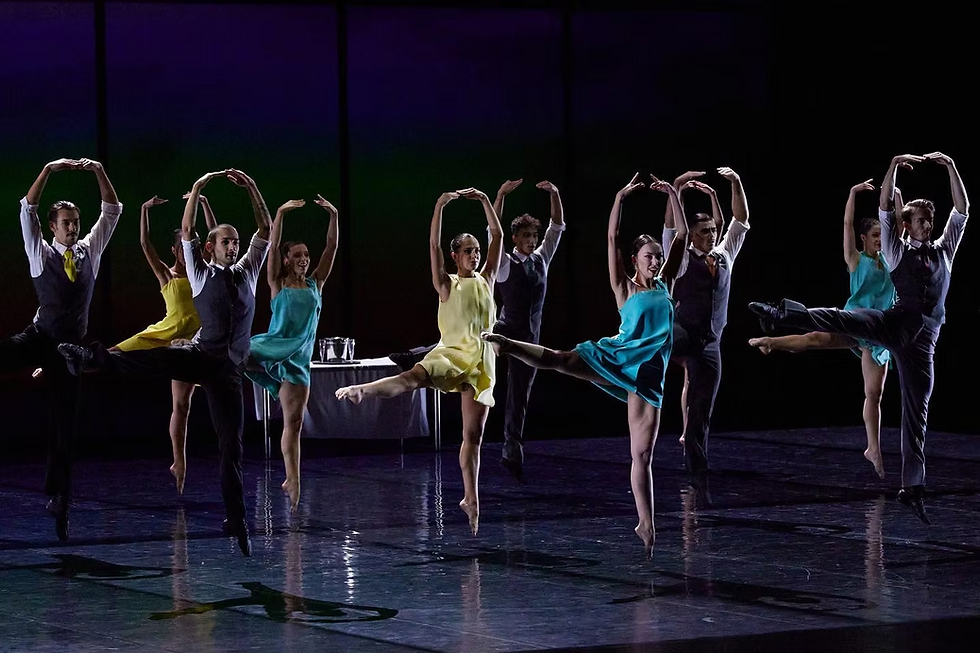
Igor Chapurin’s costumes leaned heavily into black and white symbolism, with a memorable burst of colour during the Act I party scene, where sequinned dancers glittered briefly before tumbling back into shadow. The barefoot corps de ballet, in short white ruffles, were mesmerising. Delicate yet powerful, they channelled swan-like fluidity without pointe shoes.

Preljocaj’s choreography bore little resemblance to Petipa and Ivanov’s well known romanticism. Instead, it leaned into postmodern shapes: low centres of gravity, angular limbs, and arms slicing the air like blades. The athletic movement demanded enormous stamina from the dancers. I particularly loved the sweeping unison sequences that pulsed with urgency: The swan huddle moving like a single organism. A glimmering rave party bursting suddenly into colour. The cheeky “little cygnets” variation, complete with sassy hip thrusts that drew giggles of delight from the audience. Repetition and unison built hypnotic tableaux throughout the work. A canon line of swans often rippled across the stage. The office cubicle routine saw dancers miming corporate monotony in perfect sync. A walking maze of performers moved in every direction like beautifully confused Sims.


The dancers gave nothing less than full commitment, sustaining fierce energy through the relentless two hour marathon. At times the dancers seemed to embody the entire swan through their bodies, arching their necks and extending their arms like living wings. Théa Martin’s Odette and Odile was a revelation; her Odette was fragile and lyrical, while her Odile was dominating and sharp. Antoine Dubois matched her intensity, and together their pas de deux were electrifying. Sometimes tender, sometimes brutal, and often both at once. Twisting limbs and intertwined torsos created something both terrifying and tender. It was impossible to look away.


I was lucky enough to snag a rush ticket (at just a fifth of the original cost!), which meant I could dive headfirst into this no interval two-hour endurance test on a whim. Three acts unfolded back to back with no mercy. I caught myself clenching every muscle, too nervous to cough or even shuffle in my seat for fear of breaking the spell. Sadly, not everyone shared that discipline. A pre show reminder about phone etiquette would not have gone astray. I counted no fewer than six phones ringing. In a work this immersive, those interruptions jarred.

Did every narrative moment land for me? Not entirely. But as a sensory experience of motion, image, sound, and soul, this Swan Lake was thrilling, unpredictable, and never dull. For those who feel the original ballet has grown a little dusty, this version breathed fresh (if somewhat polluted) air into the story. The final image of Odette lying lifeless while smog rose above her like a cancerous promise of progress was devastating.
And even if this interpretation is not to your taste, the production itself is undeniably an impressive feat for everyone involved. The dancers, the orchestra, and even the audience. Diehard traditionalists may still find it worth experiencing for the sheer unpredictability, and for the chance to watch swans take on capitalism with style.


Comments