


REVIEW: The Female of the Species - Cut & Run Productions, PIP Theatre

The Female of the Species
7 – 16 May 2026
Written by Joanna Murray-Smith
Produced by Cut and Run Productions as a co-production with PIP Theatre
Director – Lara Rix
Assistant Director – Aoife Kissane
Stage Manager & Sound Designer – Hannah Page
Lighting Designer – Claire Yorston
Costume Designer – Kiah Latham
Photography - Jasmine Prasser
"Women want two things from a man: fantastic foreplay and doing the tax."
Never meet your heroes. Especially if you intend to bring a gun and turn their peaceful countryside writing getaway into a feminist hostage situation with a side of family therapy.
Joanna Murray-Smith’s The Female of the Species is a satirical comedy about feminism, fame, motherhood, ego, and the disconnect between the values we preach and the lives we actually lead. Staged in 2008 by Queensland Theatre Company, Cut & Run Productions and PIP Theatre revives it with an entertainingly bold approach.

Inspired loosely by Germaine Greer's real-life incident of being held at gunpoint by a student, the play centres on famous feminist writer Margot Mason (hello alliteration!), who is struggling with a spectacular bout of writer’s block. Known for her provocative persona and intellectual fearlessness, Margot’s carefully curated authority begins to crack when former student Molly Rivers visits her home with a gun and a very personal grievance. Molly blames Margot’s notorious book, The Cerebral Vagina, for her mother’s death, and what begins as a confrontation between idol and devotee quickly escalates into a farcical reckoning.

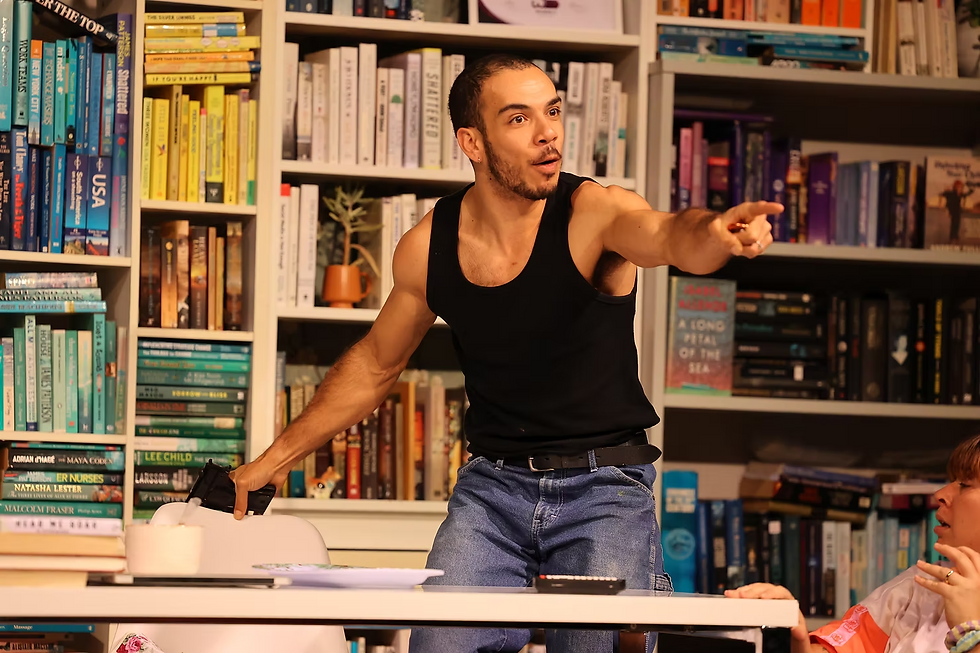
From there, more characters are unlocked: Margot’s exhausted daughter Tess barges in, looking like she just survivd a toddler apocalypse, and immediately jumps to the conclusion that her mum is having a Fifty Shades moment with the handcuffs. Hot on her heels is her bewildered husband Bryan. Then comes Frank, a disgruntled Uber driver with grievances of his own, and finally Theo, Margot’s publisher, who appears as if summoned by the scent of drama.

Having originally appeared in QTC's 2008 production as Molly Rivers, Francesca Savige now comes full circle by stepping into the slippers of Margot Mason. Her Margot is a cocktail of eloquence, vanity, bluntness, drama, and just a tad bonkers. Even when her blocking is restricted by handcuffs, Savige fills the room with undeniable presence. She has a terrific grip on Murray-Smith’s language, tossing out Margot’s interruptions and declarations with the confidence of a lecturer who expects the room to take notes. Her lines are delivered with such pristine self-importance that it makes you want to both applaud her and confiscate her fountain pen. She is insufferable in the most entertaining way, but Savige also lets us glimpse the panic beneath the polish. When Margot admits, “What if I’ve said all I have to say?”, the legendary provocateur is simply a writer facing the scary possibility that her well of inspiration has run dry.

Michaela Faux is fantastic as Molly Rivers, the former student whose admiration for Margot has curdled into something dangerous. Molly just shows up unannounced, fawning and chatting as though she and Margot are old friends. She is clearly volatile, but also oddly sweet, awkward, intelligent, and far less certain than her plan suggests. She quotes Margot back to herself like scripture, carrying fanatical reverence and traumatic grief in the same breath. Because beneath the chaos is a wounded young woman trying to make sense of her mother’s abandonment, death, and the damage left behind. What I enjoyed most is how Molly becomes strangely absorbed into this household dynamic, becoming a mix of captor and accidental emotional support.

Rebecca Day is an absolute hoot to watch as Tess, Margot’s 'oops' daughter, whose entrance sends the play into a different but equally frantic gear. Tess arrives already frazzled, having fled the overstimulating noise of her three young tornadoes only to get stuck in an Uber with a guy telling her his life story. I kept catching myself watching her antics in the background of every scene. Her line, “I am an exhausted, miserable woman with a question mark at the centre of my identity,” captures the ache beneath all that theatrical exasperation. This is a woman drowning in domestic mayhem, desperate to be seen as more than everyone else's problem-solver. The trio of women is especially strong together. Savige, Faux, and Day bounce off each other with fantastic rhythm, forming a strange little triangle of ego, grief, resentment, admiration, and shared female fatigue.

As Bryan, Josh Whitten quickly becomes a personal favourite. Bryan could easily be played as a standard clueless husband, but Whitten adds a sincerity that makes him deeply endearing. He has the energy of a man trying politely to catch a train that has already left the station. What makes Whitten so hilarious is that Bryan keeps trying to be helpful in the most Bryan way possible. In a room full of people using theory, trauma, and resentment as weapons, Bryan's gentle nature is a refreshing little pocket of softness.


Peter Hatton brings a another whirlwind of energy as Frank, the Uber driver who's fed up with life, feminists, older folks, and anything else that annoys him. Frank’s entrance widens the play’s argument beyond Margot’s family and into a broader social shouting match. He bursts in with barely a blink at the hostage situation, as though walking into a room with a gun, handcuffs, and several emotionally unstable strangers is simply another day in customer service. He has the passion of a man who has been waiting for an audience and, unfortunately for everyone, has finally found one.
Then Danny Brown arrives as Theo, Margot’s publisher, who lives for the drama, partly because he knows it might help sell books. Margot has not been answering his calls. Rude of her, really, considering she is only handcuffed to a table in an armed confrontation. Theo exudes the energy of a man who hears the word “hostage” and thinks “networking opportunity.” Brown gives him a sparkling theatricality, but keeps the observations sharp and the timing crisp.
Together, the cast gives the play its engine. These are experienced performers who know how to handle Murray-Smith’s pace, wit, and sudden pivots with ease. It is farce, debate, family therapy, identity crisis, and intellectual cage fight all at once.

Under Lara Rix’s direction, the production moves like a pressure cooker: tightly contained, rapidly heating, and always one careless moment away from blowing its lid. Rix keeps the debate intelligent without ever letting it become dry. The comedy waltzes between physical, verbal, and situational absurdity. The endless game of hot potato with the gun and handcuffs is one of the funniest devices of the show for me; like a pass-the-parcel where the prize is potential legal consequences.

The staging also makes clever use of proximity. With the audience seated on two sides, we are close enough to catch the smallest reactions and shifts in power. This suits the play beautifully, because so much of the comedy lives in watching people recalibrate in real time: who has the gun, who has the moral high ground, who is winning the argument, and who has just made everything worse?
The set places us inside Margot Mason’s world: a towering wall of bookshelves filled with hundreds of colour-coded books. It is beautiful, imposing, and I totally want it. Margot’s country home screams intellctual uperiority, telling us exactly who she is before she even opens her mouth. This is not just a home; it is a shrine to her own brilliance. Sound and lighting are meticulously timed throughout, particularly the bursts of red that heighten the danger at just the right times.

What makes this production so enjoyable is that it understands the play is not really asking us to crown one correct person. Everyone is offloading onto each other. Everyone has a point. And everyone's also being completely ridiculous. Margot has built a career on provocation but flounders when provoked. Molly wants justice but really, I think she is just lonely. Tess wants to be understood but does not even understand herself. Bryan is trying to help but cannot fully read the room. Frank is looking for someone to listen. Theo wants to save his own arse. The result is a theatrical pile-up of ideology, ego, gender politics, generational trauma, and brilliant one-liners.
Murray-Smith’s script is packed with killer dialogue, and this cast delivers it with terrific clarity and rhythm. It explores what happens when feminism becomes a brand, when motherhood becomes an identity crisis, when grief searches for a villain to blame, and when public thinkers are treated as personal prophets. It is satire with claws, but this production keeps it fun rather than didactic.
Cut & Run Productions delivers a lively, intelligent, and completely hilarious revival of The Female of the Species. It is performed by a cast who clearly relish the script’s wit and absurdity, and the whole thing is directed with a great sense of humour and humanity. The ending is a banger, and I will not spoil it, except to say that the play knows exactly when to pull one final rug.


Comments