


REVIEW: The First Night (of The One Day of the Year) - Ad Astra Theatre

Production: The First Night (of The One Day of the Year)
Production Company: Ad Astra Theatre Company
Venue: Pluto Theatre, Brisbane
Playwright: Stephen Vagg
Director: Nathaniel Currie
Lighting Designer: Kat Coomber
Photography: Christopher Sharman Photography. Date Attended: 13 November 2026
"You're very brave to try and put on an Australian play in this country!"
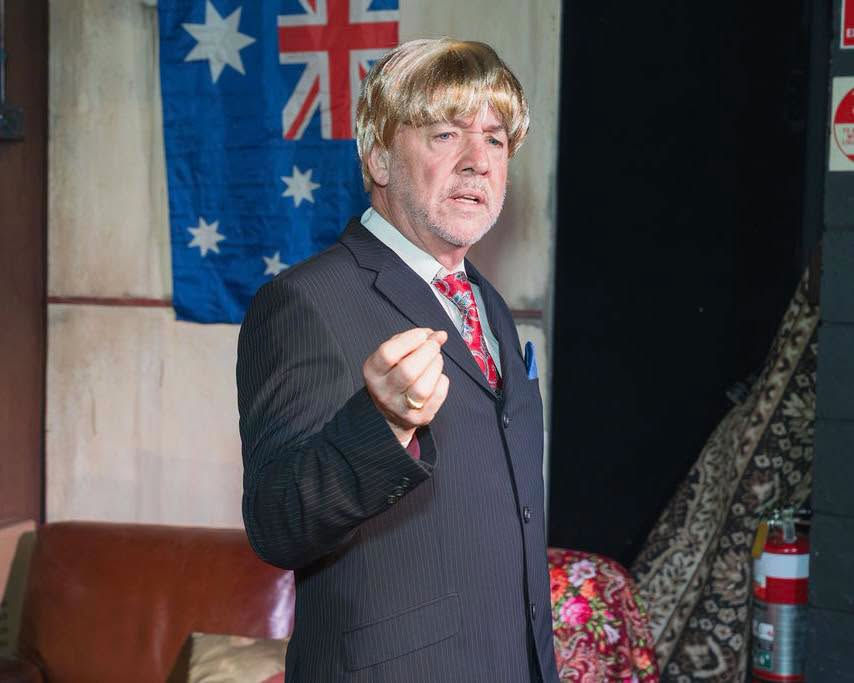
A statement that could quite easily be heard in a theatre foyer today, yet Stephen Vagg takes us back to Adelaide in 1960, when staging an Australian play was apparently an act of political rebellion. His new comedy, The First Night (of the One Day of the Year), imagines the disastrous opening night of Alan Seymour's controversial play The One Day of the Year, when just about everything that could possibly go wrong does. Murphy's Law has nothing on this theatre company.
Seymour's original play follows a father and son whose conflicting attitudes towards Anzac Day spark arguments about patriotism, remembrance, and the glorification of war. Selected for the 1960 Adelaide Festival before being withdrawn over fears of offending returned servicemen, it was eventually staged by an amateur theatre company. Its history is full of censorship, political interference, and threats of violence, giving Vagg plenty of material to work with (and a bit to invent).

Inside Ad Astra's intimate Pluto Theatre, a rundown 1960s dressing room becomes the headquarters for an increasingly desperate group of performers attempting to open their show. Between a bomb threat, missing cast members, romantic complications, and government interference, actually performing the play is rapidly slipping down their list of immediate concerns.
Director Nathaniel Currie embraces the absurdity of Vagg's script, which moves through fast-paced exchanges, exaggerated physical comedy, theatrical symbolism, and frequent commentary on the performing arts. The dialogue is dense, with an enormous amount of information and historical context to squeeze between the jokes. Fortunately, this cast is remarkably expressive, and even the lengthier conversations are animated by their increasingly dramatic behaviour.

Janaki Gerard plays Coral, an actress whose romantic entanglement with fellow performer Tony is about as subtle as a marching band in a library. Their showmance is full of exaggerated affection, dramatic declarations, and physical comedy that frequently takes advantage of their considerable height difference. Gerard is exceptionally expressive and remarkably flexible (quite literally), folding and contorting herself for a good laugh.
James Dyke as Tony is charmingly opportunistic, particularly when dealing with influential arts bureaucrats. He knows the value of a well-placed compliment, even when those in power barely disguise their contempt for Australia's less fashionable theatrical cities. Brisbane, Adelaide, Perth, and Hobart (collectively dismissed as BAPH) are hardly considered cultural priorities in the 1960s.

Jack Winrow plays Ogie with an endearingly childlike innocence. His social awkwardness and inability to recognise when he should probably stop talking mean his foot is almost permanently in his mouth. Winrow's wide-eyed expressions and earnest delivery create a character whose contributions to proceedings are usually accidental, frequently unhelpful, and very funny.
Bronwyn Nayler as Joan is the director of this increasingly doomed production (not to be confused with the real director Nathaniel Currie). Her determination to maintain some degree of artistic control becomes progressively more theatrical as everything falls apart. She's giving me Moira Rose in the dramatics department, with the same ability to treat every inconvenience as a potentially Shakespearean tragedy. Her mounting frustration is highly entertaining, but beneath all the grand gestures is a woman who genuinely loves theatre, despite the many struggles it regularly inflicts upon her.

"You can't have a lot of dignity in theatre."
At one point, she wonders why she can't simply be happy watching art instead of making it. I suspect a few theatre practitioners in the audience might relate to that... Nayler also delivers a heartfelt monologue about the peculiar community that theatre creates, and why people continue dedicating themselves to it when the rewards can be so uncertain.

Gregory J. Wilken has the considerable task of playing multiple characters, adopting a succession of distinct personalities and positions of authority. Among them are the "very humble" head of the ABC, the flamboyant Adelaide Festival recruit, and an ASIO investigator whose suspicions extend to just about everyone. Wilken is also the only performer who breaks the fourth wall, speaking directly to us and treating the audience as accomplices to his various observations. His commentary provides some of the sharpest theatrical humour, including the observation that "the most important thing in the arts is access to money." Don't we know it.
Throughout the play, the government is portrayed as a constant obstacle to creativity, whether through censorship, surveillance, bureaucracy, or its reluctance to provide financial support. There's even some wonderfully silly symbolism involving a government "cobra" biting people on the backside and the offering of literal peanuts to struggling artists. Vagg isn't particularly subtle about whom he's criticising here...

The historical setting also provides plenty of opportunities to examine Cold War paranoia, when suspicions of communist sympathies could threaten a person's reputation. The ASIO investigator's questioning is particularly revealing, with Gerard delivering an intense monologue as Coral finally loses patience with the men who insist on controlling her life and career.
"I understand why my mum went mad. Men drove her to it!"

Her anger builds as she confronts Wilken's investigator, who remains stubbornly unmoved. Gerard's delivery is fierce, and the contrast between her escalating frustration and his complete refusal to listen is infuriatingly recognisable. The scene is a pointed illustration of whose voices were considered worth hearing in 1960, and whose weren't.
Meanwhile, the cast attempts to rewrite Seymour's already controversial play to make it more politically acceptable. Although the attitudes and anxieties of 1960 are specific to their time, the parallels with contemporary arguments about artistic freedom, public offence, and who gets to decide what can be performed are difficult to ignore.


Eventually, Vagg turns his attention back to the original play's central argument about Anzac Day. A returned serviceman's admission that he only permits himself to remember the war on one day of the year offers a very different perspective on remembrance. For someone who has survived the horrors of war, forgetting can be a necessity rather than a sign of disrespect. Wilken's final appearance as a veteran with a bomb dramatically alters the atmosphere. It's an unsettling conclusion to a production that has spent most of its running time finding comedy in the absurdity of interference.
There are moments when Vagg's script becomes rather wordy, particularly as it attempts to accommodate historical explanation, political commentary, theatrical in-jokes, and multiple character stories. The energetic cast does a great deal to maintain our attention, while Currie's direction brings physical energy to even the more dialogue-heavy sections.


As a newly developed Australian work, The First Night also offered its performers the opportunity to create these eccentric characters from scratch, without generations of previous interpretations. It's exciting to see Ad Astra's Astra Nova program supporting that process, bringing Vagg's original writing from an earlier rehearsed reading to a fully staged production.
The result is a lovingly ridiculous portrait of theatre life, complete with the stubborn conviction that somehow, against all reasonable odds, the show must go on. Sixty-six years later, Australia has certainly developed a much healthier appetite for its own homegrown stories, but some of the frustrations facing artists haven't changed nearly as much as we'd like. Vagg's play has a great deal of affection for the people who persevere anyway!


Comments