


REVIEW: Witness for the Prosecution - VOX Productions
Agatha Christie's Witness for the Prosecution
Presented by VOX Productions at Metro Arts
Director / Producer: Nicky Whichelow
Co-Director: Adelle O’Connell
Stage Manager: Hazel Evans
Lighting Designer: Thomas Ranie
Sound Designer: Zoe Power
Props Master: Toni Spry
Set Design: Scott Lymbery and Nic Scotney
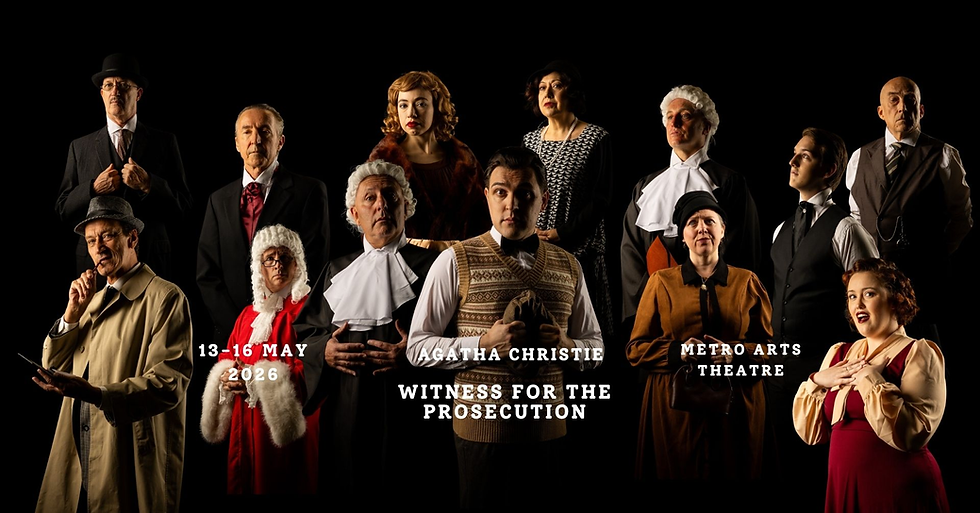
Agatha Christie knows exactly how to make an audience start silently accusing everyone on stage. With Witness for the Prosecution, VOX Productions transports us to 1950s London, a world of propriety and secrets. This courtroom drama is built on questions, contradictions, and the unsettling realisation that truth is only as reliable as the person telling it.
The play follows Leonard Vole, a young man accused of murdering a wealthy older woman. As his legal team attempts to prove his innocence, the case becomes increasingly tangled by unreliable testimony, murky motives, and the involvement of Leonard’s wife, Romaine, whose evidence threatens to unravel everything.
Presented at Metro Arts, this production is directed and produced by Nicky Whichelow, with Adelle O’Connell as co-director. Christie’s mysterious world feels formal and contained, with the audience placed firmly in the position of the jury, watching each witness and wondering who the hell is telling the truth. The pacing follows the natural rhythm of a courtroom: ask, answer, object, reconsider, and then doubt everything. Even during the preview performance, where the cast occasionally stumbled over lines, the story maintained its grip.
As Leonard Vole, Reagan Warner delivers another distinctive performance from his growing catalogue of versatile roles. Here, he is a jittery British chap in a sweater-vest and bowtie, breathlessly over-explaining everything. It made me want to reach across the room and whisper, “Please, for the love of the legal system, stop talking!” His scenes keep you unsettled as Leonard rambles, blurts things out, and only digs himself deeper with each attempt to help his own case. Leonard could be either an innocent yet naïve victim of an unfortunate coincidence or a cunning liar who knows exactly how to play the innocent; Warner's performance makes both scenarios equally believable.
David Hill gives Sir Wilfrid Robarts the composed authority of a man who has spent years untangling people’s messes for a living. Paul Hynes complements him well as Mr. Mayhew, a smart, sharply dressed solicitor with an air of professional concern. Together, they form an unflappable legal duo, always striving to stay one step ahead of everything.
Across the courtroom, Luke Friedman stands out as Mr. Myers, giving the prosecuting barrister a biting energy and a streak of sass. His delivery carries a sly theatricality, as though every pointed phrase has been sharpened and presented on a silver tray. Wayne Hinton lends The Judge an iconic vocal quality, with shades of Churchill in his command, weight, and old-school authority.
As Romaine Heilger Vole, Sandy Adsett is excellent. She speaks like an Eastern European spy — calm, swift, and ruthlessly straightforward. There are no hysterics, no theatrical pleading, no easy emotional cues for the audience to cling to. Instead, her poker face is her superpower. On the stand, with her eyes lowered, Adsett portrays both layers: Romaine as a witness providing evidence and Romaine as a witness potentially acting. This story is about the witness... not the victim, or the prisoner, or barrister in the fancy wig.
The supporting cast fills out Christie’s world with strong character detail. Toby Chittenden is wonderfully apt as Inspector Hearne, the classic Cockney copper of 1950s Scotland Yard. David Scholes makes the most of every moment as Dr. Wyatt, intentionally stammering his way through testimony and cross-examination with enjoyable specificity. Liz Hull brings Janet Mackenzie to life with a thick character accent and her nose held high. Among the polished legal men, she feels practical, watchful, and entirely capable of holding her own.
John Grey brings neat comic precision to Mr. Carter, making his particular habits and orderliness amusing without letting them take over the scene. Kailan Tyler-Moss is bright and starry-eyed as Greta, offering a lovely contrast to the very serious legal minds around her. Kip Jeffree gives the courtroom its sense of ritual and order as the Court Clerk, while Marisa Bucolo adds another shadowy thread to the mystery in an ambiguous role that reminds us that, in Christie’s world, nobody appears without a reason.
The design keeps the production functional and clear. Scott Lymbery and Nic Scotney’s set moves between the law office and courtroom with simple, recognisable pieces, including a faux fireplace for the chambers and courtroom benches that quickly place us in the formal world of British justice. It does not overcomplicate the space, which is wise for a text-driven play where the real spectacle is the evidence being rearranged in front of us.
Thomas Ranie’s lighting design helps separate the shifts between private legal conversation and public courtroom scrutiny. Zoe Power’s sound design adds a thoughtful layer of atmosphere, particularly through the jazzy pre-show and transition music. At the preview, some of the sound effects sat too loudly in the mix, but the team seemed immediately aware of this. The added audience reaction effects are also less necessary, particularly because we are directly addressed as the jury and the real audience is already reacting plenty. Christie’s twists do not need help landing.
What is especially interesting watching Witness for the Prosecution now is how much the play reveals about the assumptions of its own world. Evidence is harder to ascertain. Reputation carries enormous weight. Nationality, wealth, gender, and perceived respectability all influence how characters are judged before they have even started speaking. Prejudice sits clearly in the room without flattening the play into a lecture. Instead, it becomes part of the machinery of the mystery. Who is believed? Who is dismissed?
Having not seen an Agatha Christie in some time (and this being only my fourth Christie play overall), Witness for the Prosecution reaffirms why her work remains so theatrically satisfying. It is not just about the twists. I adore her wit, her humour, and her ability to make every answer feel like the beginning of another question.
Witness for the Prosecution is a slippery courtroom drama where loyalty is questionable, prejudice sits uncomfortably close to justice, and truth depends entirely on who is holding the floor. VOX Productions gives Christie’s classic mystery a confident staging, a strong ensemble, and central performances that keep the audience guessing right up to the final turn.


Comments