


REVIEW: Escape - Diavolo, Brisbane Festival
Updated: 11 minutes ago

ESCAPE by DIAVOLO | Architecture in Motion
Presented by: Brisbane Festival in association with Queensland Performing Arts Centre
Venue: QPAC Playhouse
Date attended: 23 September 2026
Creative Director & Choreographer: Jacques Heim
Associate Choreographer: Kate Dougherty
Writer & Dramaturg: France Nguyen-Vincent
Sound Designer & Media Specialist: Simon Larson Greenberg
Lighting Designer: Jean-Yves Tessier
Costume Designer: David Touster
Structure Designers: Adam Davis and Daniel Wheeler
Photography: George Simian, Cheryl Mann, and others
“Stability is not the absence of movement.”

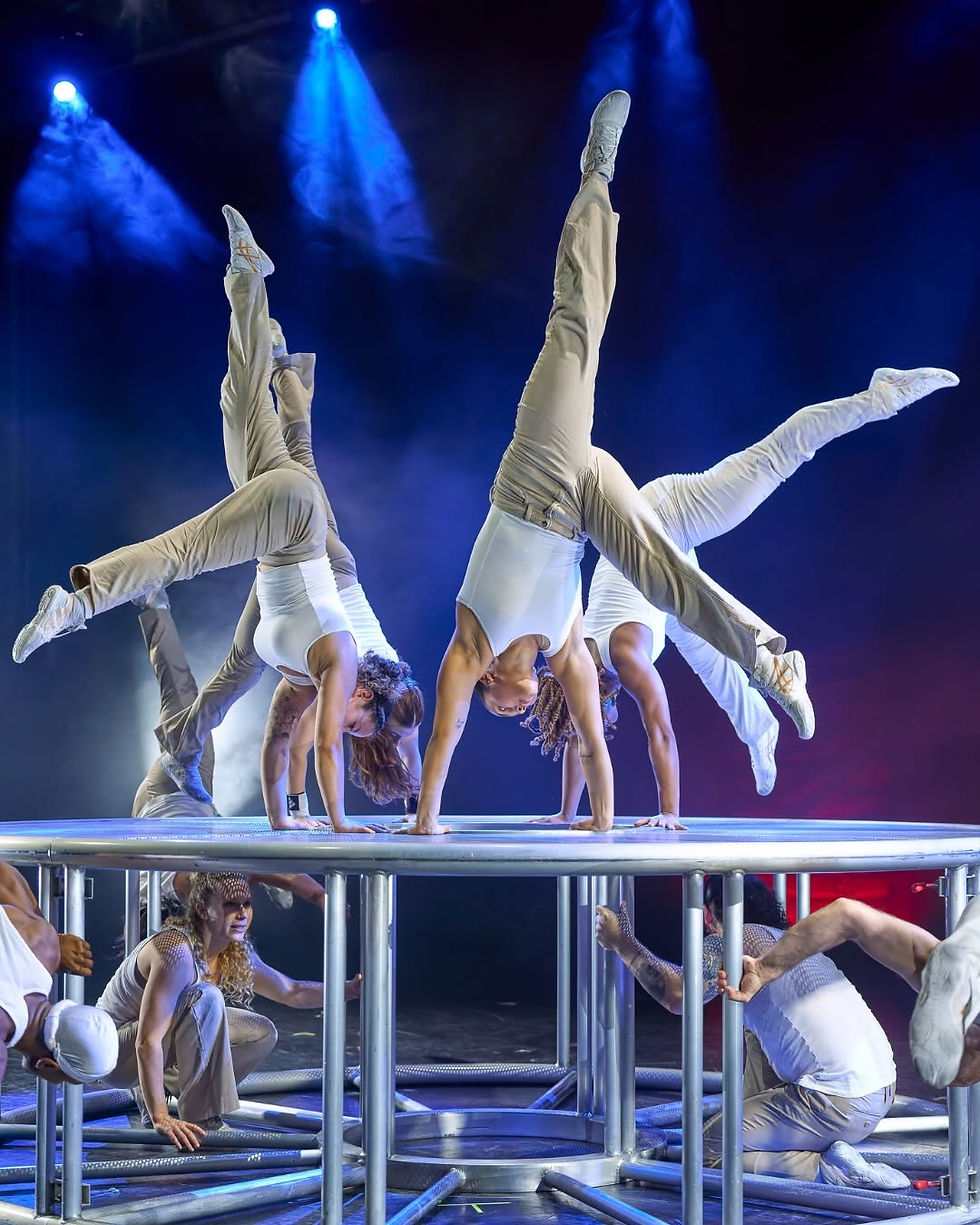
People throw themselves from cages. Doors tilt beneath dancers. Metal arcs become an enormous human hamster wheel. Bodies fling themselves through the air on the assumption that another person will be standing in exactly the right place at exactly the right millisecond. My jaw was clenched for much of the hour. My brain, meanwhile, was going weeeee!
Created by Los Angeles company DIAVOLO | Architecture in Motion®, ESCAPE began taking shape during the pandemic, when confinement had become a very literal part of daily life and the urge to get out was hardly an abstract concept. The performers move through a changing landscape of enormous engineered structures, finding themselves trapped, thrown off balance, climbing out, and relying on each other to bring them safely back down.
Their backgrounds span dance, gymnastics, parkour, acrobatics, and tricking. You can see those disciplines constantly colliding onstage. They're like very athletic monkeys who’ve been given access to expensive construction equipment. The opening cage proves the comparison immediately. Performers scramble across the metal frame, hanging, leaping, and squeezing themselves through its gaps with a kind of Tarzan abandon. My less sophisticated thought was that I would hit my shins on this thing SO much if I tried that.

A performer falls. The audience gasps. Someone catches her. This becomes a dominant rhythm throughout ESCAPE. The company repeatedly introduces the possibility of disaster, lets us imagine it for half a second, and catches the body before gravity finishes the job. There’s no room for vague timing here. The performers call across the stage and yell cues to one another, and I loved hearing the work happen. Their communication becomes part of the score of the production.
Things get angrier during the “boxed in” material. Numbered vests replace the earlier black costumes, spoken text asks “Is there anybody out there?”, and the song Another Brick in the Wall hardly needs its metaphor explained. The choreography begins with rigid unison before bodies become more agitated. The spoken language circles confinement, pressure, and a refusal to be constrained.

Even the scene changes belong to the company. They haul, rotate, assemble, and climb on this mega playground. Architecture isn’t decoration in ESCAPE. It keeps changing the rules. Curved metal pieces first behave like individual seesaws before combining into the enormous circular structure. With EDM thumping around the Playhouse theatre, performers climb through its spokes while others propel the whole contraption across the stage. Human hamster wheel feels like an undignified description for such a feat of engineering, but I mean it affectionately. This company understands physics in the coolest possible way!


In another sequence, a performer holds themselves inside a metal tube with ridiculous upper-body strength. Nearby, a rounded structure riddled with glowing holes looks like a chunk of cratered moon. Bodies pop through its craters like curious aliens. Jean-Yves Tessier’s lighting deepens that otherworldly quality, moving between stark beams, silhouettes, shadows, starlight, and pools of colour.


A contemporary duet around a single doorway turns an ordinary object into a balancing apparatus. The dancers climb its frame, counterweight one another, and hang from positions requiring iron grip! Their safety repeatedly sits in the other person’s hands. Set against “Can You Hold Me”, it’s a striking change of scale after all that machinery.
The soundscape sees EDM, rock, spoken word, drums, screams, and atmospheric music hammer through the theatre with considerable force. There are gentler stretches too. Twinkling light and softer music give us a break from all that impact. One “Falling Far” sequence had me giggling with glee. That response probably tells you where I sit on the sophisticated contemporary-dance-critic spectrum.

The biggest balancing act comes at the end. With choral voices and increasingly insistent drums underneath, an enormous boat-like structure rocks to and fro like a gigantic rocking horse. Performers scatter across it at different heights, adjusting continually as the floor beneath them rises and drops. I hope nobody got seasick! “Someone will always be there to catch you,” we’re told. After watching bodies genuinely catapulted into the air, the idea has muscle behind it. Their colleagues are quite literally the difference between completing a trick and falling.
I left with aching sympathy for their shoulders, stunned by their grip strength, and a strong desire to climb on almost every piece of equipment despite possessing none of the qualifications required to survive the attempt.
I’d definitely see ESCAPE again.





Comments